


 Some may try to act like WrathCode, but there’s only one real us — the one that builds the future of tech.
| Always verify before you trust — fraudsters can fake names, not authenticity.
Some may try to act like WrathCode, but there’s only one real us — the one that builds the future of tech.
| Always verify before you trust — fraudsters can fake names, not authenticity.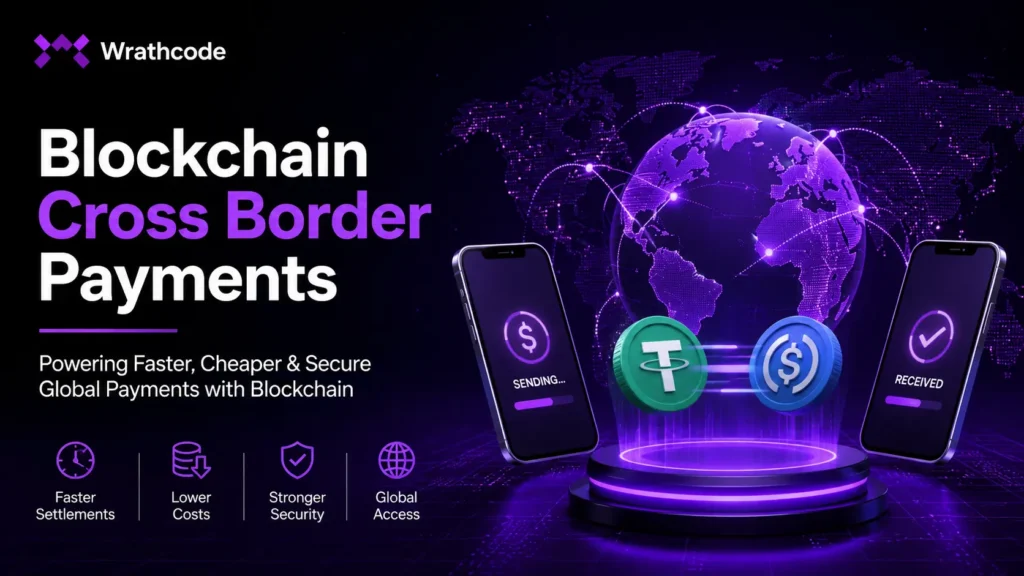
Blockchain is changing the way money moves across countries. Traditional systems often take days to process payments and charge high fees along the way. That is why many fintech firms and exchanges are now exploring blockchain cross-border payments as a faster and simpler option.
Today, crypto exchange cross-border payments can be settled in minutes instead of waiting for banks and middlemen. With stablecoins, smart contracts, and digital wallets, businesses can send funds around the clock. This also helps reduce delays linked to FX conversion in crypto exchanges and old banking networks.
As global demand grows, more companies are investing in cross-border payment integration and crypto exchange development to support secure and low-cost international transactions. From remittance apps to enterprise settlement platforms, blockchain is opening new doors for global finance.
What Is Blockchain-Based Cross-Border Payment Integration?
Blockchain-based cross-border payment integration connects crypto exchanges, wallets, banks, and payment systems through blockchain networks. Instead of relying only on traditional banking rails, transactions move through decentralized networks that can process payments much faster.
In a normal international transfer, money often passes through several banks before reaching the receiver. Each step adds fees and delays. In some cases, settlement can take three to five business days. That is one reason many businesses are now looking at blockchain cross-border payments as a modern alternative.
With payment rails and blockchain integration, crypto exchanges can move funds directly between users, wallets, or businesses. Transactions are recorded on a blockchain ledger, which makes them easier to track and verify. This creates a smoother process for crypto exchange cross-border payments, especially for companies handling global customers.
Traditional Cross-Border Payment Challenges
Traditional systems depend heavily on intermediaries. Banks, payment processors, and clearing houses all take part in the process. That setup increases operational costs and slows down settlement speed.
Another common issue is FX conversion in crypto exchanges and banking networks. Currency exchange fees can quickly pile up during international transfers. Businesses also struggle with limited banking hours and regional restrictions.
For remittance companies, this can feel like running a race with ankle weights. The system works, but it moves slowly.
How Blockchain Changes International Payments
Blockchain removes many of these middle layers. Funds can move directly between parties through on-chain cross-border settlement. In many cases, payments clear within minutes instead of days.
Stablecoins for cross-border payments also help reduce price swings during transfers. A user in one country can send digital dollars to another country without depending on several banks in between.
Many modern exchanges now combine payment gateway integration with crypto exchange systems and blockchain infrastructure to support faster global transactions and better liquidity movement.
Also read – User Experience in Cryptocurrency Exchange Software Development
How Cross-Border Payment Integration Works in Crypto Exchanges
Crypto exchanges use a mix of blockchain networks, payment gateways, wallets, and liquidity systems to move money across borders. The goal is simple: send funds faster, lower transaction costs, and reduce delays tied to old banking systems.
In a typical setup, a user deposits fiat currency or crypto into an exchange account. The platform then converts, routes, and settles the payment through blockchain infrastructure. This process supports crypto exchange cross-border payments for users, merchants, and businesses around the world.
Modern exchanges also combine off-chain settlement vs on-chain systems depending on transaction size, speed, and network costs. Small transfers may settle instantly inside the exchange database, while larger transactions move directly through blockchain networks for better transparency.
Payment Gateway Integration in Crypto Exchange
Payment gateways act like bridges between users, banks, and blockchain systems. They allow exchanges to accept card payments, bank transfers, and digital assets in one place.
With payment gateway integration crypto exchange systems, users can quickly buy stablecoins or crypto and send funds internationally. The gateway also handles transaction approvals, fraud checks, and currency processing.
For example, a user in Europe can deposit euros, convert them into USDT, and send funds to Asia within minutes. The exchange handles the heavy lifting in the background.
Wallet Infrastructure and Liquidity Routing
Wallet systems store and move digital assets securely. Most exchanges use hot wallets for fast transactions and cold wallets for long-term protection.
Liquidity routing is another key part of settlement finality and liquidity management. Exchanges connect with liquidity providers to process trades and transfers without major price gaps. This keeps transactions smooth, especially during high-volume periods.
Stablecoins and On-Chain Cross-Border Settlement
Stablecoins for cross-border payments have become a major part of global crypto transfers. Assets like USDT and USDC help reduce volatility during international settlement.
When funds move through on-chain cross-border settlement, every transaction is recorded on the blockchain. This improves transparency and helps businesses track payments more easily.
Security, Compliance, and Transaction Verification
Security matters in every payment system. Exchanges use encryption, multi-signature wallets, and monitoring tools to protect user funds.
KYC AML in cross-border crypto payments is also critical. Exchanges must verify users, monitor suspicious activity, and follow regional compliance rules. Many platforms now use automated compliance tools to manage these checks in real time.
Interoperability protocols also help different blockchain networks communicate with each other. This allows smoother movement between ecosystems without forcing users to stay on one chain.
Also read – Top 10 Cryptocurrency Exchange APIs
Benefits of Blockchain Cross-Border Payment Integration
Businesses are under pressure to move money faster and more cheaply across countries. Traditional banking systems often struggle with delays, high transfer costs, and limited operating hours. That is why many companies are turning to blockchain cross-border payments to improve global transactions.
For crypto platforms, cross-border payment integration crypto exchange systems create a smoother experience for both businesses and users. Payments become quicker, easier to track, and more flexible across different regions.
Faster Transaction Settlement
One of the biggest advantages is speed. Traditional international transfers may take several days because banks and intermediaries must approve each step. Blockchain networks work differently.
With on-chain cross-border settlement, transactions can settle within minutes. Some blockchain networks process transfers almost instantly, even during weekends or holidays.
This speed matters for exchanges handling large trading volumes or remittance transactions. Faster settlement also improves customer trust because users can track payments in real time.
Lower Transaction Costs
Cross-border banking fees can add up quickly. Intermediary banks, currency conversion charges, and processing fees often reduce the final amount received.
Blockchain systems cut many of these extra layers. That creates major cost savings, which cross-border blockchain solutions are known for. Businesses can move funds with fewer middlemen involved.
Stablecoins for cross-border payments also help lower FX conversion costs. Instead of converting through several banking systems, users can transfer digital dollars directly across borders.
Better Transparency and Tracking
Traditional payment systems sometimes feel like sending a package without tracking. Once the payment leaves, visibility becomes limited.
Blockchain networks solve this issue by recording transactions on a public ledger. Exchanges and users can track payment status from start to finish. This improves accountability and reduces disputes.
For businesses handling blockchain for remittances, transparency is especially important because customers want clear proof that funds reached the receiver safely.
24/7 Global Payment Access
Banks close at night, during weekends, and on public holidays. Blockchain networks do not.
Crypto exchange cross-border payments can operate around the clock. This helps businesses serve international users without waiting for banking windows to reopen.
For global platforms, nonstop settlement creates a better customer experience and supports faster business operations.
Reduced Dependence on Traditional Banking Systems
Many businesses still face banking restrictions for international crypto activity. Blockchain payment systems give exchanges more flexibility by reducing reliance on legacy banking rails.
With payment rails and blockchain integration, exchanges can process global payments even in regions with slow financial infrastructure. This opens access for underserved markets and growing fintech ecosystems.
Also read – How to Launch Your Crypto OTC Derivatives Trading Platform
Role of Stablecoins in International Crypto Payments
Stablecoins have become one of the most important tools in blockchain cross-border payments. They combine the speed of crypto with the price stability of traditional currencies. That makes them useful for businesses, exchanges, and remittance platforms handling international transfers every day.
Unlike regular cryptocurrencies, stablecoins are tied to assets like the US dollar. This helps reduce sudden price swings during payment processing. For users sending money across borders, that stability creates more trust and predictability.
Today, many platforms use stablecoins for cross-border payments because they simplify settlement and lower transfer friction between countries.
Stablecoin Liquidity in Crypto Exchanges
Liquidity plays a big role in fast settlement. Exchanges need enough trading volume and available assets to process transactions smoothly.
Stablecoins like USDT and USDC are widely traded across major exchanges. This helps crypto exchange cross-border payments move quickly without long conversion delays. Strong liquidity also improves settlement finality and liquidity management during high transaction periods.
For example, a business in one country can receive stablecoins almost instantly and convert them into local currency through the exchange.
Reduced Volatility Risks
Traditional cryptocurrencies can move up or down in price very quickly. That creates risk during international transfers.
Stablecoins solve much of this problem by maintaining a fixed value. A company sending $10,000 worth of stablecoins expects the receiver to get close to the same value after settlement.
This is one reason blockchain for remittances has grown rapidly in recent years. Users want faster transfers without worrying about large price changes halfway through the transaction.
Easier Multi-Currency Settlement
Stablecoins also simplify FX conversion in crypto exchanges. Instead of routing payments through several banks and currencies, exchanges can use digital dollar stablecoins as a common settlement layer.
This supports smoother payment rails and blockchain integration across global markets. Businesses can process transactions between different regions without relying heavily on slow banking systems.
Some exchanges now combine stablecoins with interoperability protocols to move assets across multiple blockchain networks. That flexibility helps reduce congestion and improve transaction speed.
Also read – Spot Trading Crypto Exchange Development
Compliance and Security Considerations
Security and compliance are two major parts of any cross-border payment integration crypto exchange system. Fast transactions are important, but businesses also need to protect user funds and follow financial regulations across different countries.
Crypto exchanges handle large volumes of global payments every day. Without proper controls, platforms can face fraud risks, money laundering issues, or legal penalties. That is why strong compliance systems are now built into most blockchain payment infrastructures.
KYC and AML Integration
KYC AML in cross-border crypto payments helps exchanges verify user identity and monitor suspicious activity. KYC stands for Know Your Customer, while AML means Anti-Money Laundering.
Most exchanges ask users to submit ID documents before accessing certain payment services. This helps reduce fraud and prevents illegal transactions from moving through the platform.
Many businesses also follow a cross-border crypto compliance checklist that includes identity verification, transaction monitoring, sanctions screening, and reporting procedures.
Transaction Monitoring and Fraud Prevention
Blockchain networks are transparent, but that does not remove security risks completely. Exchanges still need systems that can detect unusual payment behavior.
Modern platforms use monitoring tools to flag suspicious wallet activity, large transfers, or risky addresses. Some systems also use AI-based risk scoring to improve fraud detection.
This becomes especially important for blockchain cross-border payments because funds often move between multiple countries and financial systems.
Security for Wallets and Smart Contracts
Wallet protection is another key area. Exchanges usually combine hot wallets for daily operations and cold wallets for long-term storage.
Multi-signature access, encryption, and withdrawal approval systems help protect funds from hacks. Smart contracts also need regular audits because coding mistakes can create security gaps.
Strong security supports better settlement finality and liquidity management since businesses need confidence that transactions will complete safely.
Regulatory Challenges Across Borders
Regulations are different in every country. Some regions support crypto innovation, while others apply strict restrictions or licensing rules.
This creates challenges for how crypto exchanges handle cross-border payments at a global scale. Exchanges must adapt to changing laws around taxation, reporting, and digital asset transfers.
Interoperability protocols and compliance tools can help businesses manage these differences more smoothly across multiple jurisdictions.
Also read – Cryptocurrency Exchange vs Cryptocurrency Brokerage
Use Cases of Blockchain Cross-Border Payments
Blockchain payment systems are no longer just ideas on paper. Many businesses already use blockchain for cross-border payments to move money faster and lower operational costs. From remittance apps to enterprise settlements, crypto infrastructure is changing how international payments work.
As more companies adopt digital assets, crypto exchange cross-border payments are becoming part of daily financial operations in different industries.
Global Remittance Platforms
Remittance services are one of the biggest use cases for blockchain for remittances. Traditional money transfer services often charge high fees and take days to settle payments.
Blockchain networks help reduce these delays. A worker in another country can send stablecoins to family members within minutes instead of waiting several business days.
Many remittance companies now use stablecoins for cross-border payments because they offer lower fees and simpler settlement between currencies.
Enterprise B2B Payments
Large businesses also use blockchain systems for supplier payments and international settlements. Companies working across several countries need faster payment processing and better tracking.
With payment rails and blockchain integration, businesses can settle invoices directly through blockchain networks instead of relying fully on intermediary banks.
This improves transparency and supports better settlement finality and liquidity management for global operations.
Crypto Exchange Settlement Networks
Many exchanges now support on-chain cross-border settlement to handle international trading activity and withdrawals. Users can transfer assets between countries without depending on slow banking systems.
Exchanges also combine interoperability protocols with wallet infrastructure to move assets across different blockchain ecosystems. This helps improve transaction flexibility and scalability.
Some platforms use off-chain settlement vs on-chain methods together. Internal transactions settle instantly within the exchange, while blockchain settlement handles external transfers.
Merchant and E-Commerce Payments
Online businesses are also entering the space. Merchants that sell products globally can accept crypto and stablecoin payments through payment gateway integration crypto exchange systems.
This reduces currency conversion delays and simplifies FX conversion in crypto exchanges for international customers.
For smaller businesses, blockchain payments can feel like opening a faster checkout lane for global buyers.
Also read –
Essential Technologies Required for Integration
Building a strong cross-border payment integration crypto exchange system takes more than adding a wallet or payment button. Several technologies work together behind the scenes to process transactions safely and quickly.
These tools help exchanges support blockchain cross-border payments at scale while improving speed, compliance, and user experience.
Blockchain APIs
APIs connect different systems and allow exchanges to communicate with blockchain networks. They help platforms process deposits, withdrawals, wallet updates, and transaction tracking automatically.
A blockchain payment API also helps exchanges connect with banks, payment gateways, and third-party financial services. This makes payment rails and blockchain integration much smoother.
Without APIs, managing global payment operations would feel like trying to run traffic without signals.
Multi-Currency Wallet Infrastructure
Wallet systems are the backbone of crypto exchange cross-border payments. They store digital assets and help users send or receive funds securely.
Most exchanges support multiple cryptocurrencies and stablecoins to improve flexibility for international users. This also helps simplify FX conversion in crypto exchanges because users can move between different currencies faster.
Wallet infrastructure must support both speed and security, especially during high transaction volume.
Liquidity Aggregation Engines
Liquidity is critical for fast settlements. Exchanges use liquidity aggregation tools to connect with multiple trading pools and providers.
This improves settlement finality and liquidity management by reducing slippage and keeping transactions stable during market movement.
Strong liquidity also supports stablecoins for cross-border payments because users can quickly convert assets when needed.
Smart Contracts and Automation
Smart contracts automate payment execution on blockchain networks. They can release funds automatically once conditions are met.
This helps reduce manual processing and lowers operational costs. Smart contracts also improve transparency because transaction rules are written directly into the blockchain system.
Many platforms now use smart contracts to support on-chain cross-border settlement between users and businesses.
Compliance and Monitoring Tools
Security and compliance software help exchanges follow financial regulations across regions. These systems monitor suspicious activity, verify identities, and generate audit reports.
KYC AML in cross-border crypto payments has become a core part of exchange infrastructure. Automated monitoring tools help businesses manage compliance without slowing down payment speed.
Interoperability protocols also help different blockchain systems share data and process transactions more efficiently.
Challenges Businesses Should Prepare For
Blockchain payment systems offer major advantages, but they also come with challenges businesses should understand before launching global payment operations. Building secure and scalable crypto exchange cross-border payments infrastructure takes planning, technical expertise, and ongoing compliance work.
Companies entering this space must balance innovation with operational stability.
Regulatory Uncertainty Across Countries
Crypto regulations are still changing in many regions. Some governments support digital asset growth, while others apply strict rules or unclear licensing requirements.
This creates hurdles for blockchain cross border payments because businesses often operate across several jurisdictions at once. Compliance teams must stay updated on local laws, reporting standards, and tax requirements.
A strong cross-border crypto compliance checklist helps businesses reduce legal risks during expansion.
Scalability and Network Congestion
Some blockchain networks slow down during heavy traffic periods. High transaction volume can increase processing fees and delay settlement times.
This affects on-chain cross-border settlement systems that depend on blockchain confirmation speed. Businesses may need Layer 2 solutions or alternative chains to improve scalability.
Exchanges must also balance off-chain settlement vs on-chain methods to manage speed and operational costs efficiently.
Liquidity and Currency Conversion Challenges
Liquidity problems can impact transaction speed and pricing stability. Low liquidity may increase slippage during large transfers or currency swaps.
FX conversion in crypto exchanges also becomes more complex when dealing with multiple fiat currencies and digital assets across global markets.
That is why settlement finality and liquidity management remain critical for international payment systems.
Banking and Integration Barriers
Even today, some banks remain cautious about crypto-related businesses. This can make fiat onboarding and payment processing more difficult for exchanges.
Payment gateway integration crypto exchange systems may also require additional compliance checks and technical integrations before launch.
Interoperability protocols help solve some connectivity issues between blockchain networks, but integration still takes careful planning and testing.
Security Risks and Operational Responsibility
Security threats continue to evolve in the crypto industry. Wallet attacks, phishing attempts, and smart contract vulnerabilities can expose businesses to financial losses.
Companies handling blockchain for remittances or enterprise payments must invest in audits, monitoring systems, and secure infrastructure from day one.
In crypto payments, cutting corners on security can become expensive very quickly.
Future of Blockchain-Based Cross-Border Payments
The future of blockchain cross-border payments looks promising as more businesses seek faster, cheaper ways to move money globally. What started as a niche crypto use case is now becoming part of mainstream financial discussions.
Banks, fintech firms, and crypto exchanges are all investing in modern payment infrastructure. Many companies no longer see blockchain as an experiment. They see it as a long-term solution for international settlement.
One major trend is the growth of stablecoins for cross-border payments. Stablecoins already help businesses reduce delays and simplify FX conversion in crypto exchanges. As regulations become clearer, adoption may increase even faster.
Central Bank Digital Currencies, often called CBDCs, could also reshape global payments. Several countries are testing digital currencies that work alongside blockchain infrastructure. These systems may improve settlement speed and support better interoperability protocols between financial networks.
Another growing area is payment rails and blockchain integration between traditional banks and crypto platforms. Instead of competing directly, many financial institutions are now exploring hybrid systems that combine blockchain settlement with traditional banking services.
Artificial intelligence and automation may also improve KYC AML in cross-border crypto payments. Faster fraud detection, real-time monitoring, and automated compliance checks could make international transactions safer and easier to manage.
At the same time, exchanges will continue improving settlement finality and liquidity management to support larger payment volumes worldwide.
The companies that adapt early may gain a strong advantage as global finance moves toward faster digital settlement systems.
Conclusion
Global payments are changing quickly, and businesses can no longer rely only on slow and expensive banking systems. Blockchain cross-border payments give crypto exchanges and fintech companies a faster way to move money across countries with better transparency and lower operational costs.
From stablecoins and wallet infrastructure to payment gateway integration and crypto exchange systems, blockchain technology is helping modern platforms process international transactions more efficiently. Businesses also gain stronger tracking, faster settlement, and improved access to global markets.
At the same time, success depends on proper planning. Companies must focus on security, KYC AML in cross-border crypto payments, liquidity management, and regulatory compliance before scaling operations internationally.
As adoption grows, crypto exchange cross-border payments will likely become a bigger part of mainstream financial infrastructure. Businesses that prepare early can build faster, more flexible payment systems for the future.




 Contact Us
Leave a Reply