


 Some may try to act like WrathCode, but there’s only one real us — the one that builds the future of tech.
| Always verify before you trust — fraudsters can fake names, not authenticity.
Some may try to act like WrathCode, but there’s only one real us — the one that builds the future of tech.
| Always verify before you trust — fraudsters can fake names, not authenticity.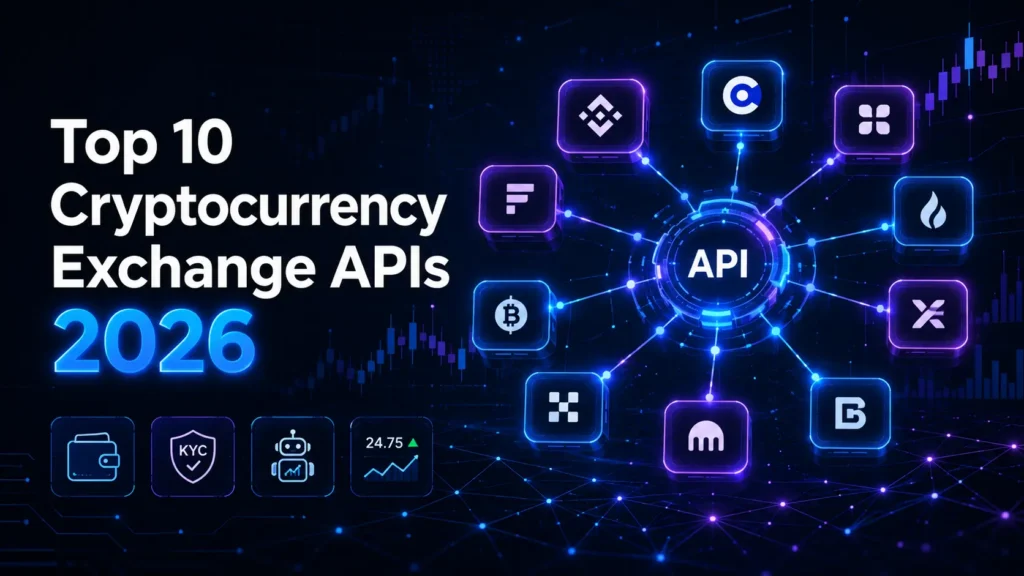
If you’ve ever placed a crypto trade and it went through in under a second, you just witnessed an API doing the heavy lifting. No drama, no delay – just a near-instant connection between your action and the exchange.
Most people have no idea this is even happening. But if you’re building a crypto platform, exploring Cryptocurrency Exchange Development, or just curious about what powers modern trading apps, this guide is for you.
I’ll break down the top 10 cryptocurrency exchange APIs in 2026 in plain, simple language – no jargon walls, no fluff.
What Is a Cryptocurrency Exchange API?
Think of an API like a waiter at a restaurant. You sit down, tell the waiter what you want, and he goes back to the kitchen and brings it to you. You never see what happens in the kitchen. That’s exactly how a crypto trading API works – you send a request, it goes to the cryptocurrency exchange platform, and it brings back exactly what you asked for: a price, a trade, your balance, whatever.
API stands for Application Programming Interface. In crypto, it’s the bridge between your app (or bot or website) and the exchange’s data. Without APIs, every developer would have to build everything from scratch. That’s not just slow – it’s nearly impossible.
Why Do APIs Matter So Much in Crypto Trading?
APIs do the behind-the-scenes heavy lifting so traders and developers can focus on the big picture. Here’s how they actually show up in real use:
Market Data Access
Want to know the live price of Bitcoin or check trading volume for the last 24 hours? APIs pull that data in real time. They give you access to order books, price charts, and historical trades without you ever touching the exchange’s servers directly.
Trade Execution
This is where it gets interesting. APIs let you — or your trading bot — place, modify, and cancel orders automatically. That’s how algo trading works. It’s not magic. It’s a well-built API responding to conditions you’ve already programmed.
Account Management
Through APIs, you can check balances, view transaction history, and manage permissions. In crypto exchange software development, this is one of the first integrations teams build, because users need to trust that their account data is accurate and accessible.
Security and Compliance
A good API comes with built-in authentication, rate limits, and key management. These aren’t just technical details – they’re what separates a trustworthy platform from a vulnerable one.
Alerts and Notifications
Want a ping when ETH crosses a certain price? APIs make that possible. Real-time notifications keep traders responsive without having to stare at a screen all day.
When you think about Cryptocurrency Exchange Development seriously, you realize quickly that choosing the right APIs isn’t a small decision. It shapes the entire platform.
Top 10 Cryptocurrency Exchange APIs in 2026
1. Price Ticker API
The Price Ticker API is probably the first one you’ll need if you’re building anything crypto-related. It gives you live price updates for any trading pair – Bitcoin to USD, ETH to BTC, you name it.
It also shows you 24-hour volume, percentage changes, and market highs and lows. Think of it as the pulse monitor of the crypto market. If you’re running a dashboard, a portfolio tracker, or any kind of display screen for traders, this is your starting point.
In 2026, real-time crypto market data API integrations have gotten faster and more accurate. Latency matters more than ever as high-frequency trading grows.
2. Wallet API
The Wallet API lets developers interact with digital wallets programmatically. So instead of a user manually copying a wallet address or signing a transaction in a separate app, the Wallet API handles it within your platform.
It supports deposits, withdrawals, balance checks, and transaction tracking. If you’re building a crypto wallet app or embedding wallet features into an exchange, this is non-negotiable.
One thing to pay attention to in 2026 is multi-chain wallet support. The best wallet APIs now work across Ethereum, BNB Chain, Solana, and more – all in one integration.
3. Historical Data API
So you want to backtest a trading strategy? Or show users how a coin performed over the last five years? That’s what the Historical Data API is for.
It gives you access to past prices, volumes, and trade data going back years. Analysts use it. Traders use it. Developers building charting tools use it constantly. It’s not the flashiest API on this list, but it’s one of the most useful.
Without solid historical data, any trading strategy is basically guessing. This API turns guesswork into informed decisions.
4. Trading Bot API
If you’re building automated trading software, the Trading Bot API is the one you’ll spend the most time with. It lets bots place orders, monitor positions, and react to market movements – all without a human clicking anything.
This API connects your strategy logic to the live exchange. You set the rules; the API executes them. It works 24/7, which is one of the biggest advantages in a market that never closes.
In 2026, trading bot APIs are smarter. Many now support AI-assisted signals, making automated strategies more adaptive than rule-based systems of the past.
5. REST API
REST API (short for Representational State Transfer) is kind of the backbone of web-based crypto exchange integrations. It uses standard HTTP methods – GET, POST, PUT, DELETE – to communicate between your app and the exchange.
It’s not specific to crypto. REST is everywhere on the internet. But in the context of a crypto exchange platform, a well-documented REST API for crypto exchange makes onboarding developers fast and integration clean.
Most exchanges offer REST APIs. The difference is in the documentation quality, uptime reliability, and how well the rate limits are managed.
6. WebSocket API
Honestly, WebSocket APIs are underrated. Most people focus on REST and overlook this one – but it’s crucial for anything that needs live updates.
Unlike REST (which you have to keep asking “any updates?” repeatedly), a WebSocket connection stays open. The server pushes data to you the moment something changes. That means live price feeds, instant order book updates, and real-time trade notifications with zero delay.
If you’re building a trading terminal or any live-data interface, skip WebSocket and your platform will feel slow. It’s that simple.
7. Payment API
A Payment API handles actual financial transactions – not just crypto trades, but payments. Credit cards, bank transfers, digital wallets, stablecoins – it can handle all of this depending on the provider.
For crypto exchanges that want to support fiat on-ramps (ways for users to buy crypto with regular money), a Payment API is essential. It connects your platform to payment processors and keeps the flow smooth for new users who don’t already hold crypto.
In 2026, payment APIs with instant settlement and multi-currency support are becoming the standard expectation, not a premium feature.
8. Merchant API
The Merchant API goes one step further than the Payment API. It’s built for businesses that want to accept crypto payments, manage orders, generate invoices, and track customer transactions from one place.
If you’re running an exchange that serves business clients – not just individual traders – the Merchant API is worth paying attention to. It handles the financial reporting side of things that regular payment APIs don’t always cover.
It’s also becoming popular among e-commerce platforms and SaaS tools that want to add crypto payment options without rebuilding their billing systems.
9. Liquidity API
Liquidity is what keeps a market healthy. If there aren’t enough buyers and sellers, prices go haywire and trades don’t fill at fair prices. The Liquidity API gives you real-time data on market depth – how much is available to buy or sell at different price levels.
For developers building exchanges, this API is critical. It tells you whether the market is deep enough for large orders and helps you integrate with liquidity providers when needed.
In 2026, exchanges that partner with multiple liquidity sources through APIs have a noticeable edge over those running thin order books.
10. KYC API
KYC stands for Know Your Customer. It’s the identity verification process that every regulated exchange has to do before letting users trade. The KYC API automates this – it verifies IDs, checks government databases, scans documents, and flags suspicious activity without a human doing each review manually.
This is one of the most compliance-critical APIs in the crypto exchange software development space. Skip it, and you’re exposing your platform to serious legal risk. Integrate it well, and user onboarding goes from a headache to a 2-minute process.
In 2026, AI-powered KYC APIs are faster and more accurate, reducing false rejections while catching actual fraud better than older rule-based systems.
Also read – Spot Trading Crypto Exchange Development
What’s New With Crypto Exchange APIs in 2026?
The API landscape has moved a lot in the last couple of years. A few things stand out.
AI is now baked into trading APIs. Predictive signals, anomaly detection, and adaptive order routing are no longer just for hedge funds. Many crypto trading API providers now offer these features out of the box.
Cross-chain support is basically expected now. An API that only works on one blockchain feels limiting. The best providers have expanded to cover Ethereum, Solana, Avalanche, and others under a single integration layer.
Security has leveled up too. Zero-trust architectures and advanced encryption are becoming baseline requirements – not optional upgrades. Any serious crypto exchange platform in 2026 is built on APIs that treat security as a first principle, not an afterthought.
For entrepreneurs working with a White Label Crypto Exchange Development Company, the good news is that most white label solutions in 2026 come pre-integrated with all of the above. You’re not starting from zero.
Also read – How to Launch Your Crypto OTC Derivatives Trading Platform
How to Choose the Right API for Your Crypto Exchange Project
Don’t just pick the one with the most features. Pick the one that fits your actual use case.
Here’s what to actually look at before committing:
Latency and speed
If your platform does live trading, even a 200ms lag is noticeable. Test the API response times before you build on top of them.
Documentation quality
Bad documentation wastes developer hours. Good documentation means your team can integrate quickly and debug easily. This sounds boring, but it saves weeks of work.
Rate limits
Most APIs cap how many requests you can send per second or per minute. Know the limits before you design your app around assumptions that don’t hold.
Security features
Look for API key management, IP whitelisting, 2FA support, and clear permission levels. If the provider doesn’t take this seriously, neither should you.
Scalability
Your platform might be small today. Plan for growth. An API that handles your current 100 users might buckle at 10,000. Ask about scalability upfront.
These questions are especially important in Cryptocurrency Exchange Development, where mistakes at the API selection stage can cost you months of rework later.
Building Your Own Crypto Exchange? Here’s What You Should Know
APIs are the backbone of any crypto exchange. You can have a beautiful UI and a solid brand, but if your APIs are unreliable, slow, or poorly integrated – your platform will feel it. Users will feel it.
The good news is you don’t have to build every integration from scratch. A lot of developers and startup founders are now going the white-label route for exactly this reason. Working with a White Label Crypto Exchange Development Company means you get a platform where the core APIs – trading, KYC, wallet, payment – are already integrated, tested, and working.
This approach cuts time to market dramatically. Instead of 12–18 months of building, many teams launch in weeks. The APIs are pre-connected. The compliance layer is already there. You’re focusing on growth, not wiring.
That said, Crypto Exchange Development still requires you to understand what’s under the hood. Even with a white-label solution, you’ll be customizing, extending, and occasionally troubleshooting these integrations. The more you understand how each API works, the better decisions you’ll make when it counts.
Final Thoughts
APIs aren’t just a developer concern. If you’re building, investing in, or even just thinking about entering the crypto exchange space, understanding these 10 APIs gives you a real edge. The crypto market moves fast, and having the right APIs in place keeps you one step ahead of platforms that are still catching up.
Start with the basics – Price Ticker, REST, and KYC. Then build outward based on what your platform actually needs. You don’t have to integrate everything on day one. But knowing what each one does means you’ll make smarter choices as you grow.
FAQs
A cryptocurrency exchange API is a set of tools and protocols that let developers connect their apps to a crypto exchange. It handles tasks like fetching prices, placing trades, managing wallets, and verifying user identities – all programmatically.
There’s no single “best” API – it depends on your use case. For live price feeds, a WebSocket API is hard to beat. For automated trading, a Trading Bot API is essential. For regulatory compliance, a KYC API is non-negotiable. Most serious platforms use several APIs working together.
APIs speed up Cryptocurrency Exchange Development by giving developers ready-made connections to market data, payment systems, KYC providers, and more. Instead of building every function from zero, teams integrate existing APIs and focus on building a better user experience.
Yes. White label solutions come with pre-built API integrations. You still need to understand how they work to configure and extend them, but you’re not writing the core API code yourself. This is why many startups and entrepreneurs choose white label options over fully custom builds.


 Contact Us
Leave a Reply