


 Some may try to act like WrathCode, but there’s only one real us — the one that builds the future of tech.
| Always verify before you trust — fraudsters can fake names, not authenticity.
Some may try to act like WrathCode, but there’s only one real us — the one that builds the future of tech.
| Always verify before you trust — fraudsters can fake names, not authenticity.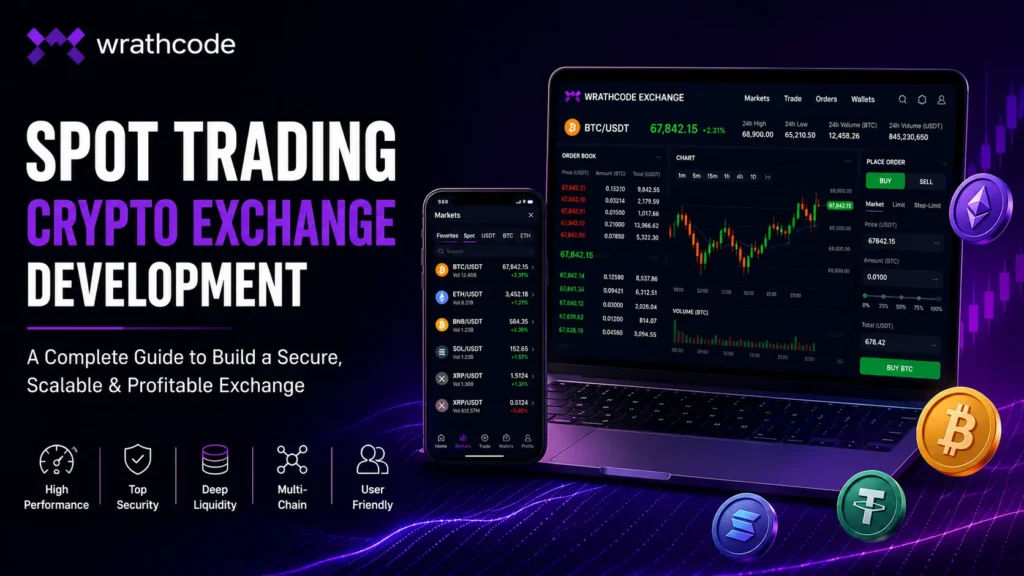
Crypto trading is moving crazy fast in 2026. According to CoinMarketCap crypto market data and Statista blockchain reports, daily crypto trading volume keeps climbing as more people jump on the bandwagon. Spot trading is leading a big chunk of that growth because it’s simple, fast, and easier for new traders to understand. Think about it like a digital bazaar for Bitcoin and altcoins. Buyers and sellers meet, trades happen instantly, and that’s it. No confusing contracts. No heavy leverage risks.
That’s why many startups begin with spot trading crypto exchange development instead of futures platforms. I’ve seen tons of founders nail this approach because spot exchanges are cheaper to launch and much easier to manage in the early days. You can focus on building users, adding liquidity, and earning trading fees before going big. Honestly, it’s a smart first move if you’re entering crypto business for the first time.
Now, if you’re planning to build spot trading platform software, there’s a lot to figure out. You need the right trading engine, wallet setup, security tools, liquidity system, and clean UI that doesn’t scare beginners away. Some founders even start with a crypto spot exchange script or white-label solution to save time and cash. Others go fully custom for better control.
In this guide, we’ll break down spot trading exchange development step by step. We’ll talk about features, costs, security, white-label options, and even revenue ideas that work in 2026. So, is this the right crypto business for you right now? Let’s find out.
What Is Spot Trading in Crypto?
Spot trading is the simplest way to buy and sell crypto. You pay the current market price, place your order, and the trade happens almost instantly. Pretty much like buying vegetables from a local market, you know? You pay, you get the item right away. In crypto, the asset goes directly into your wallet or exchange account.
A spot trading exchange works through something called an order book. That’s where buyers and sellers place their prices. The trading engine matches both sides and completes the trade in real time. Sounds technical, but the process is actually a piece of cake for users once the platform is running smoothly.
There are mainly two common order types:
- Market Order – Buy or sell instantly at the best available price.
- Limit Order – Set your own price and wait for the market to reach it.
This simple setup is why startups love spot trading exchange development. It attracts both beginners and experienced traders without the extra risks that come with derivatives trading.
Now compare this with futures trading. In spot trading, users actually own the crypto they buy. In futures, they’re mostly trading contracts tied to the asset price. That means more leverage, bigger risks, and stricter regulations. For a startup founder, futures exchanges can become messy fast.
| Spot Trading | Futures Trading |
|---|---|
| Real crypto ownership | Contract-based trading |
| Lower risk | Higher volatility |
| Beginner-friendly | Advanced traders mostly |
| Easier compliance setup | More legal pressure |
| Faster launch process | Complex infrastructure |
That’s why many companies start with spot trading crypto exchange development before expanding into futures or margin trading later. It’s faster to launch, easier to market, and gives you room to test your business model without burning through your budget.

Why Develop a Spot Trading Crypto Exchange in 2026?
Crypto adoption is getting bigger every year, and 2026 looks even more wild. Big companies, retail traders, gaming projects, and even small businesses are entering the market. According to Triple-A crypto ownership statistics, global crypto users have already crossed hundreds of millions, and spot trading still handles a massive share of daily activity.
So why are founders rushing into spot trading crypto exchange development right now?
First, spot exchanges are easier to launch compared to futures platforms. You don’t need super complex leverage systems or risky liquidation engines. That cuts development time and reduces legal headaches too. For many startups, it’s the safest way to enter crypto without biting off more than they can chew.
Another big reason is the meme coin craze. Sounds funny, but think about it – meme coins bring huge trading volume. Traders buy and sell fast, sometimes all day long. Exchanges earn fees from every trade, even if the market goes sideways. I’ve seen smaller platforms grow surprisingly fast just by listing trending community coins before bigger exchanges notice them.
Then there’s AI trading. This trend is exploding in 2026. Traders now use bots for auto-buying, portfolio balancing, and price alerts. If you build spot trading platform software with bot-friendly APIs and fast execution, you instantly attract advanced users too.
Layer-2 networks are also changing the game. Chains like Polygon and Arbitrum make transactions cheaper and quicker. That means better user experience and lower operating costs for exchanges.
On top of that, governments are pushing more compliance rules. Weirdly enough, that’s actually helping serious crypto businesses. Users trust platforms with strong KYC, proof-of-reserves, and security systems. A clean exchange now stands out more than ever.
The best part? Spot exchanges can earn money from:
- Trading fees
- Listing fees
- Premium memberships
- Staking services
- Market maker partnerships
So yeah, the opportunity is huge right now. But before launching, you need the right set of features. And honestly, this is where many founders either win big or completely mess things up.
Why You Should Choose Wrathcode for Spot Trading Crypto Exchange Development?
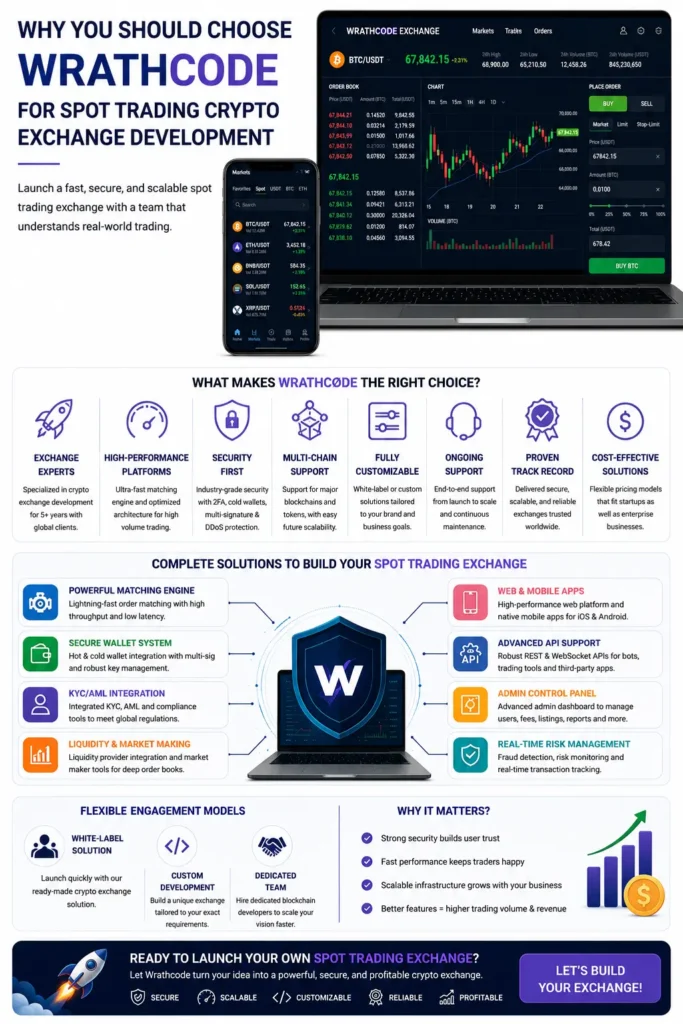
Picking the right crypto exchange development partner is honestly one of the biggest decisions you’ll make while launching a crypto exchange. A flashy website is easy to build. But creating a fast, secure, and scalable trading platform? That’s a whole different ball game.
This is where Wrathcode stands out.
The team focuses heavily on spot trading crypto exchange development with features that actually matter in real-world trading. I’m talking about high-speed matching engines, wallet integration, liquidity setup, admin controls, and strong security systems that help exchanges handle traffic without falling apart during peak trading hours.
One thing I like is that they don’t force every client into the same setup. Some startups want a quick white-label launch. Others want fully custom platforms with advanced trading tools and API integrations. Wrathcode supports both approaches, which makes things easier if you’re still figuring out your long-term business model.
Here’s what businesses usually look for before they build spot trading platform software:
- Fast deployment
- Multi-chain support
- Secure wallet systems
- KYC/AML integration
- Mobile-friendly trading
- Liquidity integration
- Trading bot APIs
- Custom branding
Wrathcode covers all of these without making the process feel confusing. And trust me, crypto development can get messy fast if communication is poor.
Another big plus is scalability. Many founders launch small and suddenly hit unexpected user growth after listing trending tokens or meme coins. I’ve seen exchanges crash during high-volume trading because the backend wasn’t built properly from day one. Wrathcode focuses on scalable architecture, which matters a lot in 2026 where trading spikes happen almost overnight.
Security is another area where you really can’t take shortcuts. The company integrates features like:
- Two-factor authentication
- Cold wallet support
- DDoS protection
- Multi-signature wallets
- Real-time monitoring
That’s important because one security issue can destroy user trust instantly.
For startups that want faster market entry, Wrathcode also offers white-label and crypto spot exchange script solutions. This helps founders launch quicker without spending months building everything from scratch.
At the end of the day, launching a crypto exchange isn’t just about coding. It’s about building something traders actually trust and use daily. And honestly, having the right team beside you can save months of stress, failed testing, and expensive mistakes later on.
Essential Features of a Spot Trading Platform
If you want users to stay on your exchange, the platform needs to feel smooth, fast, and safe. Traders don’t wait around anymore. One small lag and they move to another app in seconds. I’ve watched startups spend big money on marketing, but poor platform features killed retention almost overnight.
So before you jump into spot trading exchange development, focus on the core things that actually matter.
1. Real-Time Trading Engine
This is the heart of the exchange. The trading engine matches buy and sell orders instantly. Faster execution means better user experience. In crypto, even one-second delay can annoy active traders.
A strong engine should support:
- High TPS (transactions per second)
- Low latency
- Real-time price updates
- Large trading volume spikes
2. Advanced Order Book
The order book shows all buy and sell orders happening live. Traders use it to track demand and price movement.
Good order books include:
- Market orders
- Limit orders
- Stop-loss options
- Trade history
- Depth charts
Think about it like a stock market screen, but for crypto assets.
3. Multi-Currency Wallet Integration
Users want flexibility. Your exchange should support:
- Bitcoin
- Ethereum
- Stablecoins
- Popular altcoins
- Multi-chain deposits
Most modern platforms use both hot wallets and cold wallets for balance between speed and security.
4. KYC and AML Verification
Regulations are getting tighter in 2026. You can’t skip compliance anymore.
A proper KYC/AML setup helps with:
- Fraud prevention
- User verification
- Risk monitoring
- Legal compliance
This is one reason serious founders choose professional spot trading crypto exchange development teams instead of random freelancers.
5. Liquidity Management System
An exchange without liquidity feels dead. Nobody wants empty order books.
You’ll need:
- Liquidity provider integration
- Market maker support
- External exchange APIs
- Fast order execution
I’ve seen founders underestimate this part, and honestly, it hurts growth badly.
6. Trading Charts and Analytics
Most traders rely on charts before placing orders. Integrating tools like TradingView makes your platform look more professional right away.
Useful features include:
- Candlestick charts
- Technical indicators
- Volume analysis
- Price alerts
7. Admin Dashboard
Admins need full control over the exchange.
The dashboard should manage:
- Users
- Trading fees
- Coin listings
- Support tickets
- Revenue tracking
- Suspicious activity
8. API Integration
APIs help traders connect bots and external apps to the platform. This became huge after AI trading tools exploded in popularity.
Good APIs support:
- Automated trading
- Portfolio apps
- Third-party analytics
- Liquidity sharing
9. Strong Security System
Security can make or break your exchange overnight.
Must-have protection includes:
- Two-factor authentication
- DDoS protection
- Cold wallet storage
- Encryption
- Withdrawal limits
- Anti-phishing tools
Crypto hacks still happen all the time, so you really can’t cut corners here.
10. Mobile Trading App
Most crypto users trade from phones now. Your app should feel clean and fast, even during traffic spikes.
A good mobile app offers:
- Instant notifications
- Quick deposits
- Simple trading screens
- Biometric login
11. AI Trading Assistant
This is becoming a hot trend in 2026. Some exchanges now offer AI-based:
- Trading suggestions
- Portfolio insights
- Risk alerts
- Smart automation tools
It’s still early, but platforms adding these features are grabbing attention fast.
Step-by-Step Guide to Spot Trading Exchange Development
Building a crypto exchange sounds exciting at first. Then reality hits. There are wallets, APIs, liquidity, security checks, compliance rules, trading engines… the list keeps growing fast. That’s why many founders feel stuck before they even begin.
The good news? If you break the process into steps, it becomes much easier to manage. I’ve seen startups go from simple ideas to fully working exchanges in just a few months by following the right roadmap.
Here’s how most successful platforms handle spot trading crypto exchange development in 2026.
Step 1: Research Your Market and Target Users
Before writing a single line of code, figure out who your exchange is for.
Ask yourself:
- Are you targeting beginners or pro traders?
- Which countries will you support?
- Will you focus on meme coins, stablecoins, or major assets?
- Do users need fiat deposits?
Think about it. A platform for casual traders looks very different from an institutional exchange.
Step 2: Choose White-Label or Custom Development
This is one of the biggest decisions.
A white-label solution works best if you:
- Want faster launch
- Have limited budget
- Need ready-made features
Custom development works better if you:
- Need advanced trading tools
- Want full branding control
- Plan to scale aggressively
Many startups begin with white-label and later upgrade once revenue starts coming in.
Step 3: Define Core Features
Now it’s time to decide what your platform will actually offer.
Basic features usually include:
- Spot trading engine
- Wallet integration
- User dashboard
- Trading charts
- Admin panel
- KYC verification
- Security tools
Advanced exchanges may also include:
- Staking
- AI trading bots
- Copy trading
- Referral systems
- Multi-language support
This stage shapes the whole direction of your spot trading exchange development process.
Step 4: Pick the Right Blockchain Networks
Your blockchain choice affects speed, fees, and scalability.
Popular options in 2026 include:
- Ethereum for ecosystem size
- Solana for fast transactions
- BNB Chain for low fees
- Polygon for scaling support
Honestly, most exchanges now support multiple chains because users hate limitations.
Step 5: Develop the Trading Engine
This is the brain of the exchange.
The engine handles:
- Order matching
- Trade execution
- Real-time price updates
- Market depth calculations
A slow engine can destroy user trust quickly. Crypto traders are impatient, you know. If orders lag during market volatility, users leave almost instantly.
Step 6: Design the User Interface
Even strong backend systems fail if the platform feels confusing.
Good UI should be:
- Mobile-friendly
- Fast loading
- Beginner-friendly
- Easy to navigate
Dark mode has basically become standard in crypto now. Most traders expect it.
Simple dashboards usually perform better than flashy designs with too many moving parts.
Step 7: Integrate Liquidity Providers and APIs
Liquidity is what keeps trading active. Without it, your exchange feels empty.
Most startups connect with:
- Liquidity providers
- Market makers
- External exchange APIs
This helps create tighter spreads and faster trade execution.
Many platforms also add APIs for:
- Trading bots
- Portfolio trackers
- AI automation tools
That’s becoming a huge trend in 2026.
Step 8: Add Security and Compliance Systems
Security isn’t optional anymore. One hack can kill a project overnight.
Your platform should include:
- Two-factor authentication
- Cold wallet storage
- Encryption systems
- Anti-DDoS protection
- Withdrawal monitoring
Compliance matters too. Most exchanges now integrate:
- KYC verification
- AML monitoring
- Fraud detection
- Geo-restrictions
This protects both the business and users.
Step 9: Test Everything Before Launch
A lot of founders rush this stage and regret it later.
You need:
- Load testing
- Security testing
- UI testing
- Wallet testing
- API testing
Some companies even run bug bounty programs before launch. Smart move honestly.
Step 10: Launch and Start Marketing
Once testing is done, it’s go time.
Most exchanges grow through:
- Referral programs
- Influencer campaigns
- Telegram communities
- Twitter marketing
- Trading competitions
- Coin listing partnerships
I’ve seen smaller exchanges grow surprisingly fast after one trending token listing goes viral.
At the end of the day, successful spot trading crypto exchange development is about balancing speed, security, liquidity, and user experience together. Miss one piece, and the whole thing can wobble like a bad shopping cart wheel.
Tech Stack and Tools for Spot Trading Exchange Development
Choosing the right tech stack is a big deal in crypto exchange development. A weak setup can slow down trades, crash during heavy traffic, or create security gaps hackers love to exploit. And trust me, crypto traders don’t forgive platform issues easily.
That’s why serious founders spend time picking technologies that are fast, scalable, and stable from day one.
Let’s break it down in simple words.
Frontend Technologies
The frontend is what users see and interact with every day. It needs to feel smooth, modern, and responsive across devices.
Popular frontend frameworks in 2026 include:
- React.js
- Next.js
- Vue.js
Most exchanges prefer React because it handles real-time updates very well. That matters a lot for price charts and live order books.
A clean frontend should support:
- Fast chart loading
- Real-time updates
- Mobile responsiveness
- Dark mode
- Easy navigation
Think about it like building a trading cockpit. Everything should feel quick and easy to reach.
Backend Technologies
The backend handles all the heavy lifting behind the scenes.
This includes:
- Order execution
- User authentication
- Wallet processing
- API management
- Database operations
Popular backend technologies include:
- Node.js
- GoLang
- Python
GoLang is becoming super popular in spot trading exchange development because it handles high-speed processing really well. Exchanges dealing with large transaction volume often use it for matching engines.
Database Systems
Crypto exchanges process huge amounts of live data every second.
That’s why developers use databases like:
- PostgreSQL
- MongoDB
- Redis
Redis is especially useful for caching live trading data and reducing delays during peak traffic.
Blockchain Integration
Your exchange also needs blockchain connectivity for deposits, withdrawals, and token support.
Most modern exchanges support:
- Ethereum
- Solana
- Avalanche
- Polygon
Multi-chain support has become almost standard now because traders move assets across different ecosystems daily.
Wallet Infrastructure
Wallet integration is one of the most important parts of spot trading crypto exchange development.
Exchanges usually combine:
- Hot wallets for quick withdrawals
- Cold wallets for safer storage
Many businesses also use third-party wallet infrastructure providers to improve security and reduce operational risk.
Cloud and DevOps Tools
A crypto exchange must stay online 24/7. Even short downtime can cause angry users and financial losses.
Popular cloud and DevOps tools include:
- AWS
- Docker
- Kubernetes
- Google Cloud
These tools help scale servers automatically when trading volume spikes suddenly.
Security and Monitoring Tools
Security tools are everywhere in modern exchanges now.
Common tools include:
- DDoS protection systems
- Multi-signature wallets
- Real-time fraud detection
- AI-based monitoring systems
Some exchanges also work with companies like Chainalysis for transaction monitoring and compliance tracking.
At the end of the day, your tech stack is the backbone of the entire exchange. A good setup keeps trades fast, users happy, and the platform stable during market chaos.
Spot Trading Crypto Platform Cost and Timeline
Let’s be real. This is usually the first thing founders ask.
“How much will it cost to build a crypto exchange?”
The answer depends on what kind of platform you want. A simple white-label exchange costs much less than a fully custom platform with advanced trading tools, AI features, and deep liquidity systems.
Still, having rough numbers helps you plan better before jumping into spot trading crypto exchange development.
What Affects the Development Cost?
Several things change the final price.
The biggest factors are:
- Platform complexity
- Number of supported coins
- Blockchain integrations
- Security systems
- Liquidity setup
- UI/UX design
- Mobile app development
- Compliance tools
- Third-party API integrations
Think about it like building a house. A small apartment and a luxury villa both need foundations, but the features change everything.
White-Label Exchange Cost
White-label solutions are the cheapest and fastest option.
Most white-label platforms cost around:
- $15,000 to $60,000
This usually includes:
- Trading engine
- Wallet integration
- Admin dashboard
- KYC support
- Basic security features
- Branding customization
A white-label setup works well for startups trying to enter the market quickly without spending huge amounts upfront.
I’ve seen founders launch in under a month using this route.
Custom Spot Trading Exchange Cost
Custom platforms cost more because everything is built from scratch.
Average pricing in 2026:
- $80,000 to $400,000+
Custom development gives you:
- Full feature control
- Better scalability
- Custom UI/UX
- Advanced API systems
- AI trading tools
- Unique business models
This option makes sense if you’re planning long-term growth or targeting serious trading volume.
Timeline for Development
Now let’s talk about time.
Typical launch timelines look like this:
| Development Type | Estimated Timeline |
|---|---|
| White-label exchange | 2–6 weeks |
| Mid-level custom platform | 3–5 months |
| Enterprise custom exchange | 6–10 months |
The timeline also depends on:
- Feature count
- Team size
- Security audits
- Compliance requirements
- Third-party integrations
A lot of startups underestimate testing time. Bad idea honestly. Crypto users notice bugs very fast.
Ongoing Maintenance Costs
Launching is just the beginning.
You’ll still need budget for:
- Server hosting
- Security monitoring
- Wallet maintenance
- Liquidity provider fees
- Customer support
- Compliance updates
- Marketing campaigns
Many exchanges spend thousands monthly after launch just to keep operations smooth.
That’s why smart founders plan long-term revenue streams from the start.
Common income sources include:
- Trading fees
- Listing fees
- Premium accounts
- API access fees
- Staking services
The good part? A successful exchange can become highly profitable once trading volume starts growing consistently.
So yeah, building an exchange isn’t cheap. But with the right strategy, liquidity setup, and strong execution, the ROI can be massive over time.
Security and Compliance Best Practices
Security is probably the most important part of spot trading crypto exchange development. You can have the best design, fast trading engine, and huge marketing budget, but one security breach can wipe out user trust overnight.
And honestly, crypto users are extra careful now. Too many exchanges got hacked over the years, so traders pay close attention to safety features before depositing funds.
That’s why modern exchanges treat security like the foundation, not an afterthought.
Multi-Signature Wallet Protection
Multi-signature wallets add an extra layer of safety. Instead of one person approving transactions, multiple approvals are required before funds move.
This helps reduce:
- Internal fraud
- Unauthorized transfers
- Single-point failures
Many large exchanges use this system for treasury management and cold wallet storage.
Cold Wallet Storage
Keeping all funds online is risky. That’s where cold wallets come in.
Cold wallets stay disconnected from the internet most of the time, making them much harder for hackers to access.
Most exchanges split funds like this:
- Small amount in hot wallets for daily withdrawals
- Majority stored safely in cold wallets
Simple setup, but very effective.
DDoS Protection and Encryption
Crypto exchanges face attacks constantly. Sometimes competitors, bots, or hackers try flooding the servers to crash the platform.
Strong DDoS protection helps keep the exchange running during traffic spikes or attacks.
Good exchanges also use:
- End-to-end encryption
- Secure API systems
- IP monitoring
- Device verification
Think about it like putting multiple locks on your shop instead of just one weak padlock.
KYC and AML Compliance
Compliance rules are much stricter in 2026.
Most countries now expect exchanges to follow:
- KYC verification
- AML monitoring
- Suspicious transaction tracking
- Travel Rule compliance
This is why many businesses integrate RegTech tools directly during spot trading exchange development instead of adding them later.
It saves a lot of headaches down the road.
Proof-of-Reserves Integration
Users want transparency now. They don’t blindly trust exchanges anymore.
Proof-of-reserves systems help platforms show they actually hold customer funds properly. Big exchanges started pushing this heavily after major industry collapses shook the market.
And honestly, it’s becoming a trust signal now.
Smart Contract and Security Audits
If your exchange uses smart contracts, audits are a must.
Professional audits help identify:
- Code vulnerabilities
- Exploits
- Wallet risks
- API weaknesses
Some platforms even run bug bounty programs where ethical hackers test the system before launch.
AI-Based Fraud Monitoring
This is becoming huge in 2026.
AI systems now help detect:
- Suspicious withdrawals
- Fake accounts
- Bot abuse
- Wash trading
- Unusual transaction patterns
The faster you catch problems, the safer your platform becomes.
At the end of the day, security isn’t just about protecting money. It’s about protecting your reputation too. In crypto, trust spreads fast — but bad news spreads even faster.
White-Label vs Custom Development
This is where many founders get stuck.
Should you launch quickly with a white-label crypto exchange development? Or spend more time and money building a custom exchange from scratch?
Honestly, both options can work. It depends on your budget, goals, and how fast you want to enter the market.
I’ve seen startups waste months trying to build everything custom when a white-label setup would’ve worked perfectly for their first launch. At the same time, I’ve also seen bigger businesses outgrow cheap solutions way too fast.
So let’s break it down simply.
| Feature | White-Label Exchange | Custom Exchange |
|---|---|---|
| Launch Speed | Fast | Slower |
| Development Cost | Lower | Higher |
| Customization | Limited | Full control |
| Scalability | Moderate | High |
| Maintenance | Vendor-supported | Self-managed |
| Time to Market | Weeks | Months |
| Flexibility | Basic | Advanced |
When White-Label Makes Sense
White-label solutions are great for:
- Startups
- Small businesses
- Fast market launches
- Budget-friendly projects
Most white-label providers already include:
- Trading engine
- Wallet setup
- Admin panel
- KYC system
- Security features
That means you can launch much faster without building every feature from zero.
This route works well if your goal is to test the market quickly or validate your idea before investing heavily into full spot trading crypto exchange development.
Some founders even start with a white-label exchange, grow their user base, then later switch to custom infrastructure once revenue improves.
Smart move honestly.
When Custom Development Is Better
Custom exchanges work better for businesses planning long-term expansion.
This option gives you:
- Full branding control
- Advanced trading tools
- Better scalability
- Custom APIs
- Unique features
- More backend flexibility
If you want AI trading tools, special liquidity systems, or advanced institutional features, custom development usually makes more sense.
Of course, it also takes longer and costs much more.
So Which One Should You Choose?
Here’s the simple version.
Choose white-label if:
- You want fast launch
- Budget is limited
- You need basic trading features
Choose custom development if:
- You plan to scale aggressively
- You want advanced features
- You need complete platform ownership
There’s no perfect answer for everyone. The best choice depends on your business stage and growth strategy.
But one thing is clear – whether you go white-label or custom, user trust, liquidity, and security will still decide if your exchange succeeds or struggles.
Conclusion
Crypto trading is growing fast, and spot exchanges remain one of the best ways for startups to enter the market. They’re simpler to launch than futures platforms and much easier for beginners to use. That’s why spot trading crypto exchange development is becoming a hot business opportunity in 2026.
In this guide, we covered:
- How spot trading works
- Must-have exchange features
- Development process
- Tech stack and security
- White-label vs custom solutions
- Cost and launch timeline
The biggest lesson? You don’t need the biggest platform to succeed. You need a secure, fast, and user-friendly exchange that traders can trust.
Many startups now choose white-label solutions to launch quickly, while larger businesses go for custom platforms with advanced tools and scalability. Both approaches can work if the foundation is strong.
If you’re planning to build spot trading platform software, partnering with an experienced company like Wrathcode can make the process smoother and faster.
The crypto market still has massive room for growth. The real challenge is building an exchange users keep coming back to.
Related Blogs
Cryptocurrency Exchange vs Cryptocurrency Brokerage




 Contact Us
Leave a Reply