


 Some may try to act like WrathCode, but there’s only one real us — the one that builds the future of tech.
| Always verify before you trust — fraudsters can fake names, not authenticity.
Some may try to act like WrathCode, but there’s only one real us — the one that builds the future of tech.
| Always verify before you trust — fraudsters can fake names, not authenticity.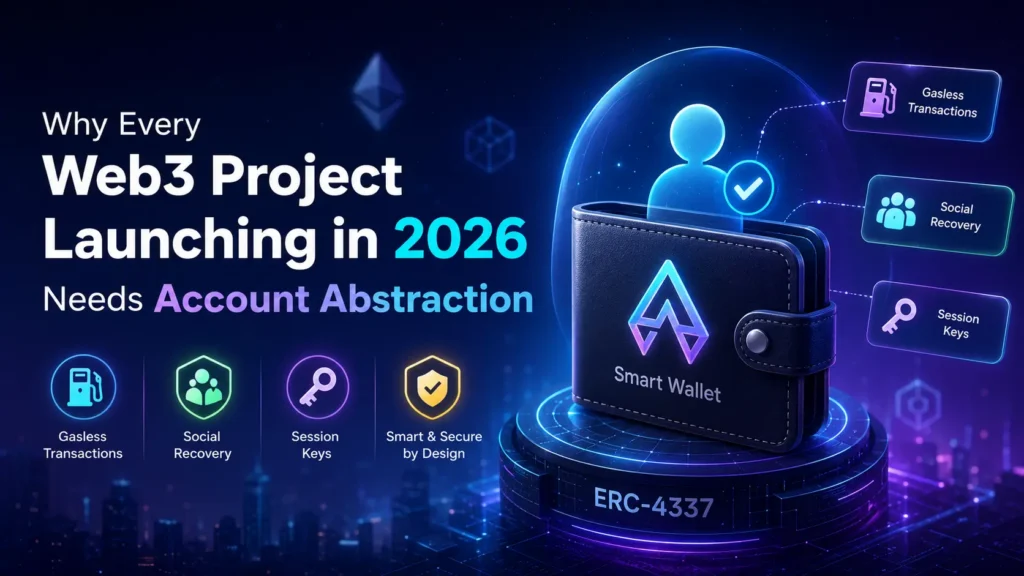
Ask any crypto founder what killed their user growth and most of them will say the same thing: the wallet. Not the token, not the tokenomics, not even the marketing. The wallet.
A new user hears about your platform, gets excited, downloads a wallet app, writes down twelve random words on a piece of paper, gets told never to lose it or share it, panics a little, and then has to buy ETH just to pay gas before they can even try your product. Half of them quit right there. This has been the biggest, quietest bottleneck in Web3 adoption for years, and in 2026 it is finally getting fixed at the protocol level through something called account abstraction.
If you are building a crypto exchange, an NFT platform, a token sale, or any dApp that needs regular people (not just crypto natives) to show up, this is worth understanding before you lock in your architecture.
What Account Abstraction Actually Means
Strip away the jargon and account abstraction is simple: it lets a crypto wallet behave more like a smart contract than a rigid key pair. Instead of a wallet being just “whoever holds this private key controls these funds,” it becomes programmable. You can set rules around it.
That one shift unlocks a handful of things that were basically impossible with a traditional wallet:
- Someone else (like the app itself) can pay the gas fee for a user’s transaction
- A lost wallet can be recovered through trusted contacts instead of a seed phrase that’s gone forever
- A user can approve a session once and keep using the app for a while without signing every single click
- Multiple approvals or spending limits can be baked directly into the wallet’s logic
The technical standard behind most of this is ERC-4337, and it’s been live long enough now that it’s moved from “interesting whitepaper idea” to something teams are actually shipping.
Why This Matters Right Now, Not Later
A few years ago this would have been a nice-to-have. In 2026 it’s closer to table stakes, for a couple of reasons.
First, adoption has actually scaled. Smart wallets built on this standard have crossed well into the millions of deployments across Ethereum and its layer 2 networks. That’s not a niche experiment anymore, that’s infrastructure other serious products are standing on.
Second, the entire industry’s attention has shifted toward onboarding normal users, not just crypto veterans. Between clearer regulation, institutions entering the space, and real-world asset tokenization picking up, the projects that win in 2026 are the ones that feel usable to someone who has never touched MetaMask before. A twelve-word seed phrase is not a good first impression for that audience.
Third, if you’re building anything that needs mainstream reach, whether that’s a fantasy sports app, a trading platform, or an NFT marketplace, your competitors are already looking at this. The teams that ignore wallet UX are going to lose users to the teams that don’t.
The Three Features Founders Actually Care About
You don’t need to understand every line of the ERC-4337 spec. You need to know what it buys you as a business.
Gasless transactions
Your app can sponsor the gas fee so a new user’s first few actions don’t require them to already own crypto. This alone removes one of the biggest drop-off points in any onboarding flow.
Social recovery
Instead of “lose your seed phrase, lose everything forever,” a user’s wallet can be recovered through a set of trusted contacts or backup methods. Support tickets about locked-out accounts drop, and users trust the platform more because losing access isn’t catastrophic anymore.
Session keys
A user approves a session once, then interacts with your app for a set period without re-signing every action. If you’ve ever built or used a product where every single click needed a wallet pop-up, you already know how much friction this removes.
Where This Actually Shows Up In Real Products
This isn’t just theory, it maps directly onto the kind of platforms already being built across the industry.
A crypto exchange benefits enormously from this because onboarding speed is everything in that business. Our crypto exchange development work covers how wallet infrastructure fits into that stack.
An NFT marketplace has the exact same problem in a different costume: buyers who want to browse and purchase without first becoming a crypto expert. Smart wallet features make that browsing-to-buying path shorter, which is something we think about closely in our NFT aggregator marketplace projects.
Token sales and ICOs have their own version of this too. Investors showing up to a sale need a wallet they can trust and recover, especially when real money is involved. That’s part of what we build into our ICO development process, alongside the compliance and smart contract side of things.
And more broadly, any custom blockchain build benefits from thinking about this early rather than bolting it on later. It’s one of the core pieces we now factor into our blockchain development services from the architecture stage onward.
What It Actually Takes To Build This Properly
This is where a lot of teams underestimate the work. Account abstraction isn’t a plugin you drop into an existing app. It involves a few moving pieces working together correctly:
- A bundler that packages user operations and gets them onto the chain
- A paymaster that handles the logic of who pays gas and under what conditions
- Smart contract wallet code that’s been properly audited, since bugs here mean funds at risk
- A clear recovery and permission model that’s actually secure, not just convenient
Get any of these wrong and you’ve traded seed phrase problems for a different, possibly worse set of problems. This is one of those areas where cutting corners shows up later as a security incident, not just a bad review. It genuinely needs a team that has done this before and understands where the sharp edges are.
How We Approach This At Wrathcode
We’ve built enough crypto exchanges, token platforms, and NFT products to have watched this exact onboarding problem play out again and again from the client side. Account abstraction is now something we bring up early in project scoping, not as an afterthought once the core product is done.
That means when we’re architecting a wallet layer, we’re thinking about gasless onboarding for first-time users, recovery flows that don’t create support headaches down the line, and session handling that makes the app feel less like crypto software and more like a normal app people already know how to use. You can see more about how we structure this kind of work on our blockchain development services page, or check our track record on our about us page.
If you’re planning a crypto exchange, NFT platform, token sale, or any product that needs real users (not just crypto insiders) to onboard smoothly, this is worth a conversation before your architecture is locked in. Reach out and we can walk through what it would look like for your specific build.



 Contact Us
Leave a Reply