


 Some may try to act like WrathCode, but there’s only one real us — the one that builds the future of tech.
| Always verify before you trust — fraudsters can fake names, not authenticity.
Some may try to act like WrathCode, but there’s only one real us — the one that builds the future of tech.
| Always verify before you trust — fraudsters can fake names, not authenticity.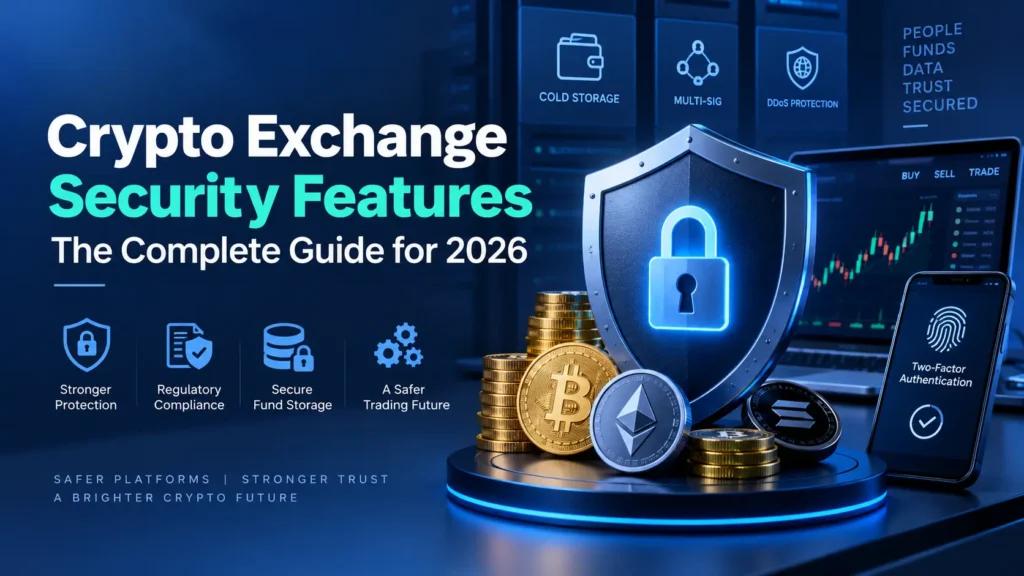
If you have ever read the news about a crypto exchange losing millions of dollars overnight, you already know why security is not a “nice to have” anymore. It is the whole ballgame. Traders will forgive a slow app or a plain-looking dashboard. They will not forgive losing their money.
In 2026, the exchanges that are winning user trust are not just the ones with the most coins listed or the lowest fees. They are the ones that can prove, in plain language, exactly how they keep funds and data safe. This guide breaks down the security features every crypto exchange platform needs, why each one matters, and how they differ depending on the type of exchange you are building.
Whether you are a founder planning your first crypto exchange development project or a business owner trying to understand what your development partner should be building for you, this is the roadmap.
Why Security Isn’t Optional for a Crypto Exchange Anymore
Here is the thing about crypto that makes it different from a regular bank. If someone steals money from a bank account, the transaction can often be reversed or insured. Crypto does not work that way. Once funds leave a wallet, they are gone. There is no customer service line that can call the blockchain and ask for a refund.
That is exactly why security has become the number one thing users check before they trust an exchange with their money. Regulators are paying closer attention too, especially around how platforms handle customer verification and fund custody. An exchange that treats security as an afterthought is one bad day away from losing everything it built.
The good news is that the playbook for doing this right is well understood. It just needs to be built in from the ground up, not bolted on after launch.
Core Security Features Every Crypto Exchange Needs
Let’s get into the actual features. Some of these will sound familiar if you have used any major exchange. Others work quietly in the background, which is exactly where good security should live.
1. Two-Factor and Multi-Factor Authentication
This is the front door lock. Two-factor authentication, or 2FA, means a password alone is not enough to log in or approve a withdrawal. Users also need a one-time code from an app, a text message, or better yet, a hardware security key.
Hardware keys and passkeys are quickly becoming the gold standard because they are nearly impossible to phish. A hacker can trick someone into typing a password on a fake site, but they cannot fake a physical security key sitting in someone’s pocket. Any exchange built today should support at least app-based 2FA by default, with hardware key and biometric login options for users who want extra peace of mind.
2. Cold Storage and Hot Wallet Balance
Think of cold storage like keeping most of your cash in a bank vault instead of the cash register. Cold wallets are kept completely offline, away from any internet connection, which means a remote hacker simply cannot reach them.
Exchanges only keep a small percentage of total funds, usually under 5 to 10 percent, in “hot wallets” that are connected online for day-to-day withdrawals. The rest sits in cold storage, often split across multiple secure locations. This one practice alone has prevented some of the biggest potential losses in the industry’s history.
3. Multi-Signature Wallets
A multi-signature, or multi-sig, wallet requires more than one private key to approve a transaction. Instead of one person or one server having the power to move funds, it might take two out of three, or three out of five, authorized signers to agree.
This matters because it removes the “single point of failure” problem. If one key gets compromised, the funds are still safe because the attacker would need the other keys too. Many teams building a white label crypto exchange solution now treat multi-sig wallet setup as a baseline requirement, not an upgrade.
4. End-to-End Encryption
Every piece of sensitive data moving through an exchange, from login credentials to personal identification documents, needs to be encrypted both while it travels and while it sits in storage. This is called encryption in transit and encryption at rest.
Good encryption practice also touches how the platform itself is built. Solid blockchain development services will bake encryption standards into the architecture from day one rather than patching them in later, because patched-in security tends to have gaps.
5. DDoS Protection and Infrastructure Hardening
A distributed denial-of-service attack floods a platform’s servers with fake traffic until it crashes. For a crypto exchange, even a short outage during a volatile market can cost users real money and cost the platform its reputation.
Modern exchanges use traffic filtering, rate limiting, and cloud-based DDoS mitigation services to absorb these attacks before they ever reach the core trading engine. This kind of infrastructure hardening should be tested regularly, not just set up once and forgotten.
6. KYC and AML Compliance Checks
Know Your Customer and Anti-Money Laundering checks are not just regulatory boxes to tick. They are a genuine security layer that keeps bad actors from using an exchange to move stolen or illegal funds. Identity verification, document checks, and ongoing transaction monitoring all work together here.
This is one area where the rules change fast depending on the region an exchange operates in, so the compliance system needs to be flexible enough to adjust without a full platform rebuild.
7. Withdrawal Whitelisting and Time-Delay Controls
Address whitelisting lets users lock their account so withdrawals can only go to pre-approved wallet addresses. If a hacker somehow gets into an account, they still cannot send funds anywhere except the addresses the real owner already approved.
Pairing this with a short time delay on large withdrawals gives users a window to cancel a transaction they did not authorize. It is a small feature that has quietly saved a lot of people from losing everything.
8. Regular Security Audits and Bug Bounty Programs
No platform is perfectly secure the day it launches, and honestly, none ever will be. What separates trustworthy exchanges from risky ones is how often they check their own work. Third-party smart contract audits, penetration testing, and code reviews should happen on a regular schedule, not just before launch.
Bug bounty programs also matter here. Paying ethical hackers to find weaknesses before criminals do is one of the smartest investments an exchange can make. This is especially critical for platforms built on smart contract development, since a single flaw in a contract can be exploited the moment it goes live.
9. Real-Time Fraud Monitoring
Behind the scenes, a well-built exchange is constantly watching for unusual patterns. A login from a new country, a sudden spike in withdrawal size, or rapid-fire trades that look like bot activity can all trigger automatic flags. These systems use machine learning to catch threats early, often before a human even needs to step in.
10. Proof of Reserves
Proof of reserves is a way for an exchange to publicly show it actually holds the funds it claims to hold. This usually involves cryptographic verification methods like Merkle tree proofs, combined with independent audits. It builds trust because users do not have to just take the exchange’s word for it, they can verify it themselves.
Security Needs Change by Exchange Type
Not every exchange is built the same way, and the security priorities shift depending on the model.
A centralized exchange (CEX) holds custody of user funds directly, so custody security, cold storage ratios, and internal access controls matter most. A decentralized exchange, on the other hand, does not hold user funds at all, which shifts the risk almost entirely onto smart contract security. Anyone exploring decentralized exchange development needs to treat contract audits as the top priority rather than an afterthought.
Peer-to-peer platforms carry a different kind of risk since users are trading directly with each other. Here, escrow systems, dispute resolution tools, and identity verification do the heavy lifting. A solid P2P crypto exchange development build needs escrow logic that locks funds automatically the moment a trade starts, so neither side can walk away with the other’s money.
And for businesses launching under their own brand through a ready-made platform, the security bar should be just as high as building from scratch. It just gets delivered faster.
What It Costs a Business When Security Gets Skipped
The math here is simple. A single security breach does not just cost the funds that get stolen. It costs user trust, and trust is nearly impossible to win back once it is gone. Users leave, bad press spreads fast, and regulators start asking harder questions.
Compare that to the cost of building security in properly from the start. It is a fraction of what a breach costs, and it is honestly a fraction of the overall development budget for a serious exchange project. Security is one of those areas where cutting corners never actually saves money, it just delays the bill.
There is also a quieter cost that gets overlooked: a clunky, overly complicated security process can frustrate real users just as much as weak security scares them off. The best platforms balance airtight protection with an experience that still feels smooth, which is a topic worth its own deep dive into user experience in crypto exchange software.
How Wrathcode Builds Security Into Crypto Exchanges From Day One
At Wrathcode, we do not treat security as a checklist added at the end of a project. It shapes the architecture from the very first line of code. Every exchange we build, whether it is a fully custom platform or an advanced crypto exchange development project with high-frequency trading needs, goes through the same discipline: cold and hot wallet separation, multi-sig approval flows, encrypted data handling, independent audits, and compliance systems that can adapt as regulations shift.
We have built this into platforms across different markets and exchange models, and the lesson has stayed the same every time. Security that is designed in from the start is cheaper, stronger, and far less stressful than security that gets bolted on after something goes wrong.
FAQs
There is no single “most important” feature since real security comes from layers working together. That said, cold storage for the majority of funds and multi-signature wallet controls are usually considered the foundation everything else builds on.
Most well-run exchanges keep somewhere between 90 and 98 percent of total user funds in cold, offline storage, with only a small operating balance kept in hot wallets for daily withdrawals.
Not exactly. Since a DEX does not hold custody of user funds, the biggest risk shifts to smart contract vulnerabilities. Regular contract audits and formal verification become far more important than wallet custody controls.
Proof of reserves is a method that lets an exchange show, through cryptographic verification, that it actually holds the assets it claims to hold. It matters because it lets users independently confirm the platform isn’t operating on thin air.
Timelines vary based on features and compliance requirements, but a properly secured exchange, from planning through security testing, typically takes several months rather than weeks. Rushing this stage is where most preventable breaches come from.
Final Thoughts
Building a crypto exchange without strong security is like building a house without locks on the doors. It might look fine from the outside, but it is only a matter of time before something goes wrong. The features covered here, from cold storage and multi-sig wallets to real-time fraud monitoring and proof of reserves, are not extras. They are the baseline for earning and keeping user trust in 2026.
If you are planning to launch a secure, scalable crypto exchange, the team at Wrathcode can help you get it right from the first line of code. Get in touch to talk through your project, or learn more about who we are and the platforms we have built.




 Contact Us
Leave a Reply