


 Some may try to act like WrathCode, but there’s only one real us — the one that builds the future of tech.
| Always verify before you trust — fraudsters can fake names, not authenticity.
Some may try to act like WrathCode, but there’s only one real us — the one that builds the future of tech.
| Always verify before you trust — fraudsters can fake names, not authenticity.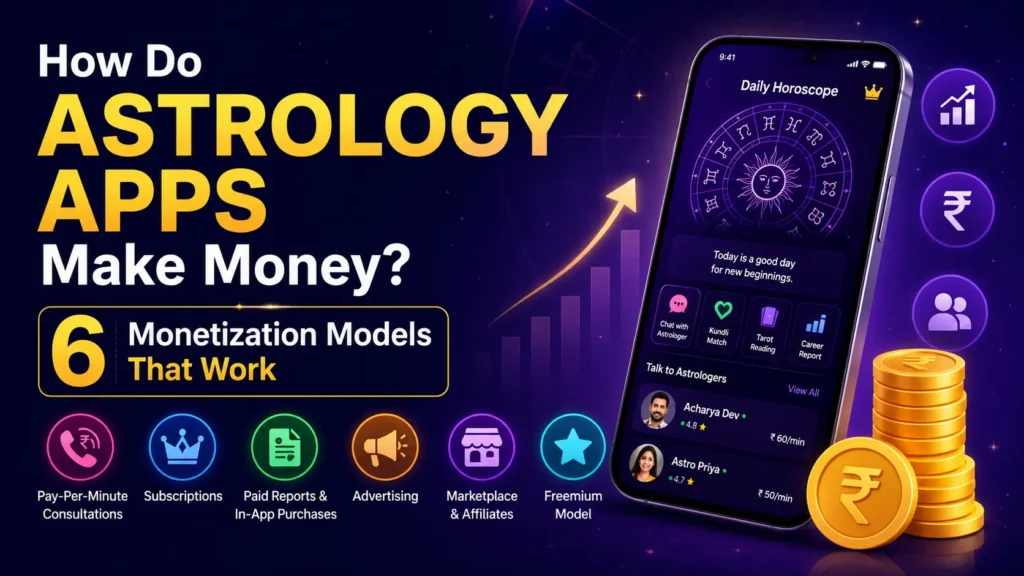
Most astrology apps are free. You download them, you check your horoscope, and you never pay a rupee.
So how did one of them earn Rs 1,214 crore in a single year?
That is not a rounding error. AstroTalk’s total revenue grew 85% in FY25, as reported by Outlook Business. The app is still free to install. The money comes from somewhere else entirely.
If you are thinking about building an astrology app, this is the question that matters more than features, more than design, more than tech stack. How does the thing actually pay for itself?
This guide breaks down the six models that work. Not theory. Real numbers, with sources you can check.
Why Astrology Apps Are Built to Print Money
Before the models, understand why this category works so well.
People come back every day
A food app gets opened when you are hungry. A shopping app gets opened when you need something. An astrology app gets opened every single morning, because tomorrow is always uncertain and today’s horoscope is always new. That daily habit is gold.
The emotion is already there
Nobody opens an astrology app out of boredom. They open it because they are worried about a job, a marriage, a health scare, a decision they cannot make. When someone is anxious, they will pay for clarity. That is the engine underneath every model below.
The market is climbing fast
The global astrology app market is projected to grow from $4.73 billion in 2025 to $5.69 billion in 2026, according to Research and Markets, which puts the growth rate above 20% a year.
Put those three things together and you get a business where users show up daily, arrive emotionally invested, and belong to a market that keeps getting bigger. That is a rare combination.
Now, the six ways to turn that into revenue.
Model 1: Pay-Per-Minute Consultations
This is the one that pays the bills.
Here is how it works. Your app is a marketplace. On one side you have users. On the other side you have verified astrologers. A user picks an astrologer, tops up a wallet, and starts a chat or a call. The meter runs by the minute. Your platform takes a cut of every rupee that changes hands.
The astrologer sets a rate, usually somewhere between Rs 10 and Rs 100 per minute, and the platform typically keeps 30% to 50% of that. You do not pay the astrologer a salary. You do not carry inventory. You take a slice of every conversation.
How big can this get? At AstroTalk, consultations make up roughly 90-95% of total revenue, per this breakdown of the company’s numbers. Everything else the app does is a side dish. The main course is people paying to talk.
The company now works with more than 13,000 verified astrologers and has served over 4.3 crore customers, based on filings sourced from the RoC.
Why it works so well: the astrologer takes on the actual work. Your app just needs to bring people through the door, keep the calls stable, and take its cut.
What it demands from you: real-time chat and calling that does not drop. A wallet system that never loses a paisa. Fair astrologer payouts, on time, every time. If your calling infrastructure is shaky, this model falls apart in a week.
Model 2: Subscriptions
The classic app play. Users pay monthly or yearly to unlock the good stuff.
Premium tiers usually include detailed daily readings, full birth chart breakdowns, compatibility deep-dives, and an ad-free experience. In the West, this is the dominant model. Co-Star has racked up over 20 million downloads and pulls in roughly $400,000 a month, going by compiled market data. CHANI was the highest-grossing astrology app in the United States as of November 2025, according to AppMagic data on Statista.
Now here is the part that nobody talks about, and it should change how you plan.
Subscription penetration in astrology apps sits at just 6% to 9% globally, per this analysis of the horoscope and astrology app market. That means for every 100 people who install your app, somewhere between six and nine of them ever pay you a subscription fee.
Read that again if you were planning to build your whole business on monthly plans.
Subscriptions are not bad. They are predictable, they compound, and investors love the recurring revenue. But if you build for subscriptions alone, you are leaving 90-plus percent of your users on the table. They still cost you money to acquire. They just never pay you back.
Best used as: one layer in a stack, not the whole floor.
Model 3: Paid Reports and In-App Purchases
Not everyone wants to sign up for a monthly plan. Plenty of people just want one answer, right now.
That is what one-time purchases are for. A user pays for a single item and walks away happy:
- A full Kundli report
- A marriage matching report between two charts
- A yearly prediction
- A career or money forecast
- A tarot spread or palm reading
- A remedy report with gemstone and puja suggestions
The pricing is friendly, usually Rs 99 to Rs 999, so the decision is easy. No commitment, no recurring charge, no second thoughts.
Free tools are the hook
Here is the smart bit. The way you get people to buy a paid report is to first give them something useful for free.
Small calculators cost almost nothing to run and pull people in like a magnet. A Mulank calculator gives someone their root number in a few seconds. A Bhagyank calculator shows them their destiny number just as fast. Neither one takes real effort to build.
But the person who used it now knows something about themselves and wants to know more. That is the exact moment to offer the full report. You gave them a taste for free, and the appetite did the rest.
Free tools also happen to be brilliant for SEO, which means they bring in traffic you never had to pay for. Two birds, one stone.
Model 4: E-Commerce
Once someone trusts your astrologer, they will buy what your astrologer recommends. That is not a theory, it is a proven business.
AstroTalk launched its own store in November 2024. In its first year it brought in over Rs 140 crore and processed more than 1.6 million orders across roughly 300 products, reported by BW Disrupt. Rudraksh, gemstones, bracelets, idols, puja items.
Think about why that worked. The astrologer tells you that a yellow sapphire will help your career. You already paid to hear that advice, so you already believe it. Then a “buy now” button appears. The sale is halfway done before it starts.
The catch: e-commerce is a different beast from software. Now you have inventory, suppliers, shipping, returns, and fake-product complaints. If a customer gets a chipped gemstone, they blame your app, not the vendor.
Start with a small catalogue. Verify your suppliers. Do not bite off more than you can chew.
Model 5: Advertising
If you have a big free user base, ads turn your non-paying users into revenue anyway.
The formats that work:
- Banner ads running along the bottom of horoscope screens
- Video ads between sections
- Rewarded ads, where a user watches 30 seconds and unlocks a bonus reading
Rewarded ads are the best of the three, and it is not close. The user chooses to watch. They get something they want. Nobody feels tricked. Compare that to a banner ad, which people have trained themselves to ignore completely.
Be honest about the ceiling, though. Ad money is small money. You need enormous traffic before it moves the needle. Ads work best as a floor under your revenue, catching the users who would otherwise be worth nothing to you.
Warning: do not blanket a paying user with ads. Nothing kills a Rs 999 subscription faster than an ad popping up in the middle of a birth chart.
Model 6: Affiliate and Brand Partnerships
The quietest of the six, but the margins are excellent because you sell nothing yourself.
You simply recommend things and take a cut:
- Meditation and wellness apps
- Astrology books and courses
- Puja booking services
- Wellness brands targeting the same audience
- Sponsored content from spiritual brands
The audience overlap is almost perfect. Someone who reads their horoscope every morning is exactly the person who will try a meditation app.
Do not expect this to carry your business. It is a nice bump on top of everything else, not a foundation.
Which Model Fits Your Market?
This is where most founders get it wrong. They copy Co-Star’s subscription playbook and launch in India. Or they copy AstroTalk’s consultation model and launch in the US. Both stumble.
The two markets behave completely differently.
| India and South Asia | US, UK, Europe | |
|---|---|---|
| Main revenue model | Pay-per-minute consultations | Subscriptions |
| What users want | A real astrologer, on the phone, right now | A polished app with smart daily content |
| Willingness to subscribe | Low | Moderate |
| Willingness to pay per session | Very high | Low |
| E-commerce potential | Very strong | Weak to moderate |
| Typical price point | Rs 10-100 per minute | $5-20 per month |
| What matters most | Astrologer supply and trust | Content quality and design |
In India, people want to talk to a person. Astrology is woven into real decisions like marriage, property, and career. They will happily spend Rs 500 on a twenty-minute call and never once consider a monthly plan.
In the West, astrology is more about identity and self-reflection. Users want a beautiful app with clever writing. A live call with a stranger feels strange to them.
Build for the wrong one, and you will be pushing water uphill.
The Numbers Nobody Shows You
Models are useless without unit economics. So let’s talk about the money underneath.
Customer acquisition cost: AstroTalk reportedly spends around Rs 600 to Rs 900 to acquire a paying customer, with a lifetime value near Rs 1,500. That works out to roughly a 3:1 LTV to CAC ratio, and the acquisition cost is typically recovered in six to eight months, based on this analysis of the company’s economics.
Profit is not automatic. Here is the reality check. Despite crossing Rs 1,200 crore in revenue, AstroTalk’s net profit for FY25 actually fell to about Rs 33 crore, down from Rs 85.5 crore the year before. Total expenses more than doubled to Rs 1,129 crore. On average, the company spent Rs 0.96 to earn every Rs 1 of revenue, per the RoC filings.
Sit with that number for a second. A market leader, at massive scale, spending 96 paise to earn a rupee.
Revenue is not the same as profit. Marketing eats a lot. Astrologer payouts eat a lot. Support and infrastructure eat the rest. Anyone who tells you astrology apps are easy money has never run one.
The good news is the model does scale. The lesson is that it scales on retention and repeat usage, not on ad spend.
Why Monetization Fails
Three mistakes sink most astrology apps.
1. One revenue stream
Founders pick subscriptions and stop there. Then they learn that only 6-9% of users ever subscribe, and the math falls apart. Putting all your eggs in one basket has never been a great plan, and here it is a fast way to burn through your runway.
2. Charging too early
A paywall on day one, before the user has felt any value, is a shot in the dark. Give them a free daily horoscope, a free chart, a free calculator. Let them get hooked. Then ask.
3. Astrologer churn
In the consultation model, your astrologers are your product. If payouts are late, or the commission is greedy, they will leave and take their repeat clients with them. Treat them like partners, not suppliers.
What Your Revenue Stack Should Look Like
If you are starting out, do not try to run all six at once. Build in this order:
Phase 1 (launch): Free daily horoscope and free tools to bring people in. Pay-per-minute consultations as your only paid product. Get the calling and wallet working perfectly before you touch anything else.
Phase 2 (3-6 months in): Add paid one-time reports. Kundli, matchmaking, yearly forecasts. These are pure margin and easy to sell to people who already trust you.
Phase 3 (6-12 months in): Layer on subscriptions for your power users and switch on rewarded ads for the free crowd.
Phase 4 (once you have a real base): Open a small store. Start with 20-30 verified products and expand from there.
Each phase pays for the next. That is the whole point
Ready to Build It?
The astrology app market is not slowing down, and the playbook is no longer a mystery. Consultations bring the revenue. Reports bring the margin. E-commerce brings the loyalty. Ads catch whatever is left.
The hard part is the build. Real-time chat that never drops mid-reading. A wallet that reconciles to the paisa. Accurate Kundli generation. Astrologer payouts that run like clockwork. Get any of those wrong and no monetization model on earth will save you.
At Wrathcode, we build astrology apps with the revenue model designed in from day one, not bolted on later. Kundli engines, live consultation systems, wallet and payout infrastructure, subscription tiers, and in-app stores.
Tell us your idea. We will show you what it takes to make it pay.




 Contact Us
Leave a Reply