


 Some may try to act like WrathCode, but there’s only one real us — the one that builds the future of tech.
| Always verify before you trust — fraudsters can fake names, not authenticity.
Some may try to act like WrathCode, but there’s only one real us — the one that builds the future of tech.
| Always verify before you trust — fraudsters can fake names, not authenticity.
The crypto market has grown fast in the last few years. New exchanges keep popping up as more users start trading digital assets. For many founders, this looks like a strong business opportunity. But building an exchange from scratch is not easy.
A white-label crypto exchange solution is now becoming a popular way to enter this space. It helps businesses launch faster without building everything from zero. This is why many startups and fintech teams are moving in this direction.
Want to start your own Crypto Exchange? Contact Wrathcode Crypto Exchange Development team and book a Free Demo Now!!
Why is launching a crypto exchange challenging?
Starting a crypto exchange involves more than just coding a website. You need a secure trading engine, wallet systems, and strong backend support. This falls under full-scale crypto exchange development, which takes time and money.
Costs can go very high. A custom build also needs a skilled team and months of work. On top of that, there are legal rules, compliance checks, and security risks to handle. For many startups, this becomes a big hurdle.
The emergence of white-label solutions
To solve these problems, ready-made platforms entered the market. A white-label crypto exchange works like a pre-built system that you can brand as your own.
It gives you a shortcut. Instead of building from scratch, you use an existing crypto exchange software solution and launch much faster. This makes it easier to test a crypto exchange business model without heavy upfront risk.
What Is a White-Label Crypto Exchange Solution?
A white-label crypto exchange solution is a ready-made platform that lets you run your own crypto exchange without building it from scratch. It comes with core systems already built. You just customize the look, add your brand, and go live.
This approach is popular with founders who want to move fast. Instead of long development cycles, they use a pre-built setup and focus on growth, users, and revenue.
Basic definition
A white-label crypto exchange is a pre-developed platform sold by a provider. You buy or license it, rebrand it, and offer it as your own exchange.
Think of it like renting a fully built store. You change the logo, colors, and name, but the structure stays the same. This is why it’s often called a ready-made crypto exchange.
How it works
The process is simple and usually follows a few steps:
- You choose one of the best white-label crypto exchange providers
- You select features and pricing plans
- The provider sets up the platform on your server or cloud
- You customize branding (logo, UI, domain)
- You test the system and go live
This setup helps you launch a cryptocurrency exchange quickly without deep technical work.
Key components included
Most platforms come with essential crypto exchange platform features built in.
- Trading engine (handles buy/sell orders)
- Wallet integration (store and transfer crypto)
- Admin dashboard (manage users and transactions)
- Liquidity integration (for smooth trading)
- Basic security features (encryption, 2FA)
These elements form the backbone of a complete crypto exchange software solution, ready to use with minimal setup.
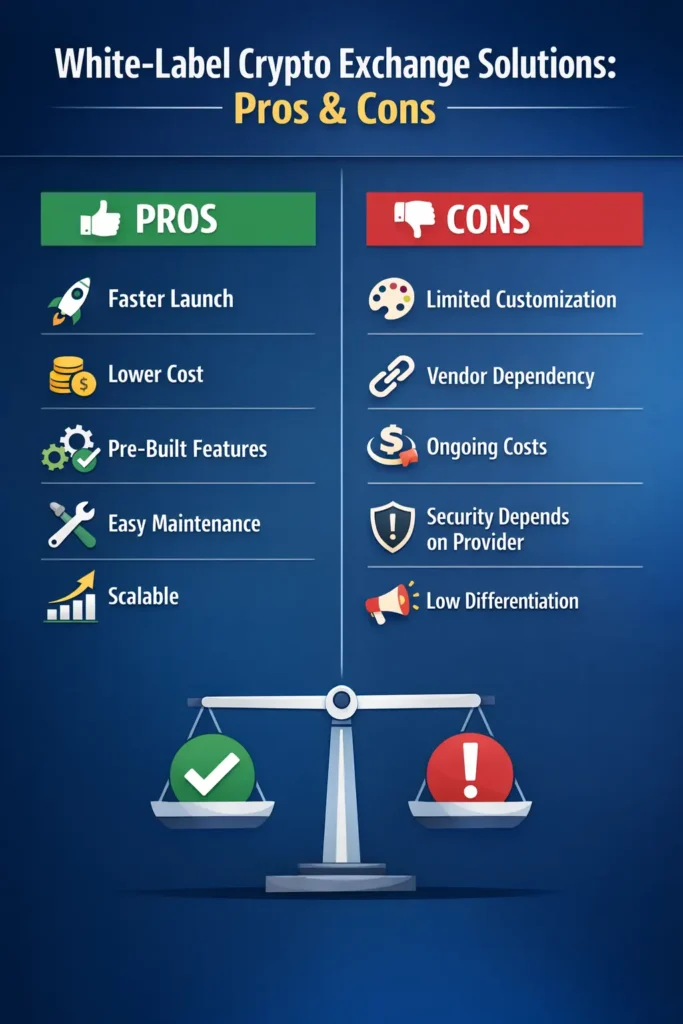
Pros of Using a White-Label Crypto Exchange Solution
A white-label crypto exchange is often chosen for speed and cost reasons. It removes many barriers that slow down new businesses. For founders who want to enter the market fast, it offers a practical starting point.
That said, the value is not just about speed. It also reduces technical pressure and lowers early risk.
Faster time to market
Building from scratch can take 6–12 months or more. That includes planning, coding, testing, and fixing issues.
With a white-label crypto exchange, most of that work is already done. You can go live in a few weeks. This speed matters when market trends change fast and timing affects growth.
Lower development cost
Full custom crypto exchange development is expensive. You need developers, designers, security experts, and ongoing testing.
A white-label setup cuts most of these costs. The white-label crypto exchange cost is usually lower because you’re using an existing system instead of building a new one.
Pre-built features and tested infrastructure
A big advantage is access to ready systems. Most platforms include core crypto exchange platform features like trading, wallets, and admin tools.
Since the system is already tested, the risk of major bugs is lower. This makes a ready-made crypto exchange more stable at launch.
Easier maintenance and support
With a white-label model, the provider handles updates and fixes. You don’t need a large in-house tech team.
This saves time and lets you focus on marketing, users, and scaling your crypto exchange business model.
Scalability options
Many providers design their platforms to handle growth. As your users increase, the system can scale with more traffic and trading volume.
This means you can start small and expand later without rebuilding the entire platform.
Cons of Using a White-Label Crypto Exchange Solution
While a white-label crypto exchange solution offers speed and lower cost, it also comes with trade-offs. These are important to understand before making a decision. Not every business will find it the right fit, especially if long-term control is a priority.
Limited customization
You can change branding, but deep changes are often restricted. Layout, features, and workflows may have limits.
This can affect how your platform looks and feels. If your goal is a highly distinct product, a white-label crypto exchange may fall short.
Dependency on the provider
You rely on the vendor for updates, fixes, and new features. If they delay changes, your business is affected too.
This creates a level of lock-in. Your roadmap depends partly on the provider’s direction, not just your own plans.
Security concerns
Security depends on the provider’s system quality. If the base platform has gaps, your exchange inherits that risk.
That’s why choosing a secure crypto exchange software solution is critical. Always check audits and past performance.
Ongoing licensing or revenue sharing
Some providers charge monthly fees or take a cut per trade. These costs add up over time.
So while initial white-label crypto exchange cost is lower, long-term expenses can increase as you grow.
Lack of product differentiation
Many platforms use similar templates and features. This makes it harder to stand out in a crowded market.
In a white-label vs custom crypto exchange comparison, custom builds offer more freedom to create something different.
White-Label vs Custom Crypto Exchange Development
Choosing between a ready-made platform and a custom build is a key decision. Both paths have pros and cons. It depends on your budget, timeline, and long-term goals.
In a simple view, white-label is about speed and lower risk. Custom is about control and flexibility.
| Factor | White-Label Crypto Exchange | Custom Crypto Exchange Development |
|---|---|---|
| Cost | Lower upfront cost | High initial investment |
| Time to launch | Few weeks | Several months |
| Flexibility | Limited customization | Full control |
| Scalability | Depends on provider | Fully customizable |
| Security control | Shared responsibility | Full ownership |
| Maintenance | Handled by provider | In-house responsibility |
When custom development makes sense
Go for custom if you want full control over features and user experience. It fits businesses with strong funding and long-term plans.
If your idea needs advanced tools or a new approach, custom crypto exchange development is the better route. It also helps when you want a strong brand identity.
When white-label is the better choice
A ready-made crypto exchange works best when speed matters. It’s ideal for startups with limited budgets or teams.
If you want to test a crypto exchange business model or enter the market fast, a white-label crypto exchange is a smart starting point.
Who Should Use a White-Label Crypto Exchange Solution?
Not every business needs to build from scratch. A white-label crypto exchange solution works best for those who want speed, lower cost, and a simpler setup. This section helps founders see if it fits their situation.
Startups and early-stage founders
Startups often work with tight budgets and small teams. Building a full platform is hard at this stage.
A white-label crypto exchange reduces cost and setup time. It lets founders focus on users, marketing, and early traction instead of heavy crypto exchange development.
Entrepreneurs testing a crypto business idea
If you’re unsure about demand, it’s risky to invest heavily at the start.
A ready-made crypto exchange gives you a low-risk way to test your idea. You can validate your crypto exchange business model without spending months on development.
Companies entering crypto from other industries
Many fintech, gaming, or e-commerce firms want to enter crypto but lack technical expertise.
Using a crypto exchange software solution like white-label helps them launch quickly and expand their offerings without building new systems internally.
Agencies offering crypto solutions to clients
Agencies can use white-label platforms as a service. They can offer exchange setup to clients without building the tech themselves.
This creates a new revenue stream using existing tools from best white-label crypto exchange providers.
How to Choose the Right White-Label Crypto Exchange Provider
Picking the right development partner is a key step. The platform you choose will shape your product, costs, and long-term growth. Not all providers offer the same quality, so it’s worth taking time to compare options.
Check security features
Security should be your first filter. Look for features like encryption, two-factor authentication, and cold wallet support.
Also check if the provider has done third-party audits. A strong crypto exchange software solution should have a proven security track record.
Evaluate customization options
Even with limits, some platforms allow better branding than others.
Check how much you can change in design, layout, and user flow. This matters if you want your white-label crypto exchange to stand out.
Review pricing structure
Pricing models can vary a lot. Some charge a one-time fee, while others take monthly payments or a share per trade.
Understand how each model impacts your white-label crypto exchange cost over time, not just at launch.
Assess technical support and updates
You’ll depend on the provider for fixes and upgrades.
Check their support system, response time, and update frequency. Good support can save you from major downtime issues.
Look at past projects and reviews
Always review past work. Check case studies, client feedback, and live platforms.
This helps you judge whether the provider is among the best white-label crypto exchange providers or not.
Quick Checklist Before You Decide
Before you commit, take a step back and review the basics. This quick checklist helps you avoid costly mistakes and choose the right path for your business.
Budget clarity
Know how much you can invest. This includes upfront cost and ongoing expenses.
Compare this with expected white-label crypto exchange cost and future growth plans.
Timeline requirements
Decide how fast you need to go live. If speed is critical, a white-label crypto exchange solution makes more sense.
If time is not an issue, you can explore other options.
Feature requirements
List what your platform must have. Focus on core crypto exchange platform features first.
Separate must-have features from optional ones. This keeps your setup simple.
Long-term scalability needs
Think beyond launch. Consider how many users you expect in the next 1–2 years.
Your platform should handle growth without major changes.
Risk tolerance
Decide what matters more—speed or control.
A white-label approach is faster and easier. Custom crypto exchange development gives more control but needs more time and money.
Conclusion
A white-label crypto exchange solution is a practical choice for many businesses. It helps you enter the market fast and with lower upfront cost. You get access to ready systems, basic features, and ongoing support.
But it’s not perfect. You trade flexibility for speed. Customization is limited, and you depend on the provider for updates and changes.
In a white-label vs custom crypto exchange decision, the right choice depends on your goals. If you want quick launch and lower risk, white-label works well. If you need full control and a highly distinct product, custom is the better path.
In simple terms, white-label is best for getting started fast. Custom development is better for building something fully your own over time.




 Contact Us
Leave a Reply