


 Some may try to act like WrathCode, but there’s only one real us — the one that builds the future of tech.
| Always verify before you trust — fraudsters can fake names, not authenticity.
Some may try to act like WrathCode, but there’s only one real us — the one that builds the future of tech.
| Always verify before you trust — fraudsters can fake names, not authenticity.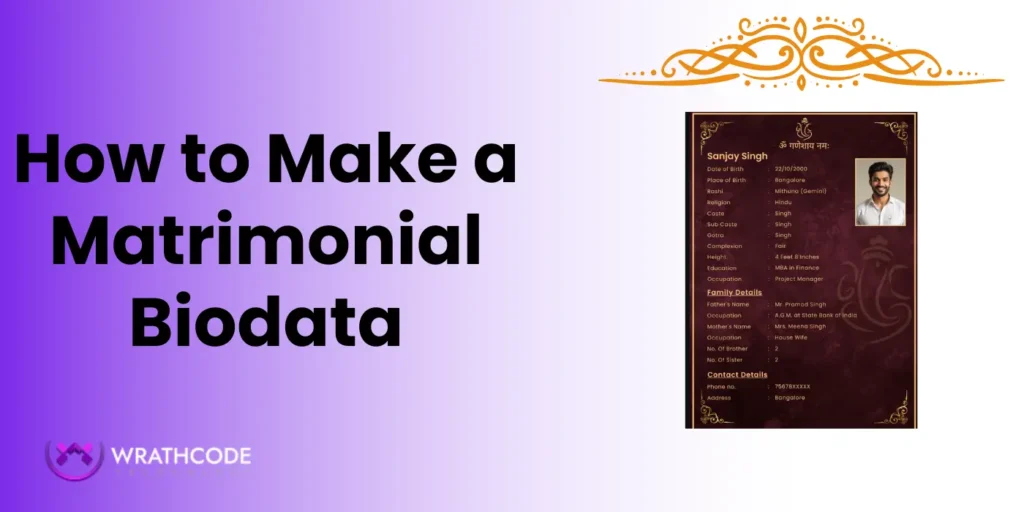
A matrimonial biodata is a simple document that shares important details about a person for marriage.
It helps families understand background, education, work, and values—quickly and clearly.
The good news?
Making one is easy when you follow the right structure.
In this guide, you’ll learn:
- What a matrimonial biodata really is
- What details do Hindu families expect
- How to write it step by step
- How to avoid common mistakes
No fancy words.
No confusion.
Just clear help you can use right away.
What Is a Matrimonial Biodata?
A matrimonial biodata is a one-page profile shared for marriage discussions. Hindu families use it to check basic compatibility before moving ahead.
Think of it like an introduction. Simple. Respectful. To the point.
It usually includes:
- Personal details
- Education and job
- Family background
- Lifestyle habits
Unlike a resume, it is not about achievements.
It is about clarity and values.
Most families read it in less than two minutes. So every detail should be easy to scan.
Why it matters
- Saves time for both families
- Avoids long calls without clarity
- Creates a good first impression
A neat biodata shows honesty and respect. That alone builds trust early.
Also read – Dating Telegram Group Link
How to Make a Matrimonial Biodata?
In today’s digital era, you can create matrimonial bio data just in 1 click. It will save you a lot of time, because when you create from scratch, it takes more time to finalize the design and writing.
There are multiple bio data maker avaible online. When you search on Google “Online Matrimonial Biodata Maker“, then 100 websites will come up in front of you. Just fillin your data, and it will provide you with the best bio data according to your requirement.
I am telling 1 more easy way to create matrimonial biodata in 1 minute. Open Chat GPT / Google Gemini on your mobile or laptop, and give a simple prompt after adding your data. “According to my data, write matrimonial biodata. ”
After adding this prompt, you will get the amazing biodata. After getting your biodata in text format, go to Canva. There are hundered templates of Matrimonial biodata available. Simply copy your ChatGPT output and paste in canva template. That’s it you bio data is ready.
Also read – Best Indian Dating Apps
Step-by-Step Guide to Making a Matrimonial Biodata
We have already seen what Matrimonial biodata is and how we make it. Now, let’s understand the biodata piece by piece. What information should be in biodata, and in which form, which things we should include, and which not?
Follow these steps in order. Keep everything clear and honest.
Step 1 – Personal Details
Start with basic personal information. This is the first thing families look at.
Include:
- Full name
- Date of birth
- Age
- Height
- Place of birth
- Caste and sub-caste
- Gotra
- Complexion
Write in bullet points. Do not write full sentences.
Example:
- Name: Rahul Sharma
- Date of Birth: 12 March 1996
- Height: 5’9”
- Caste: Brahmin
- Gotra: Bharadwaj
Keep it factual. No extra words.
Step 2 – Education Details
Next comes education. Only add what matters.
Include:
- Highest qualification
- College or university
- Year of completion
You do not need school details unless asked.
Example:
- Education: B.Tech in Mechanical Engineering
- College: IIT Roorkee
- Year: 2018
That’s enough.
Step 3 – Professional Information
This section shows work stability.
Be honest here.
Include:
- Job title or business type
- Company name or industry
- Work location
- Annual income (optional)
Example:
- Occupation: Software Engineer
- Company: Private IT Firm
- Location: Bengaluru
Do not exaggerate income. Clarity matters more than numbers.
Step 4 – Family Background
Hindu families care a lot about this section. Write it with respect.
Include:
- Father’s name and occupation
- Mother’s name and occupation
- Number of siblings
- Family location
Example:
- Father: Rajesh Sharma, Business
- Mother: Sunita Sharma, Homemaker
- Siblings: One younger sister (unmarried)
- Family Location: Jaipur
No long descriptions.
Step 5 – Lifestyle and Preferences
This part shows daily habits and values.
Include:
- Diet (veg / eggetarian)
- Smoking or drinking habits
- Hobbies
- Expectations from partner (optional)
Example:
- Diet: Vegetarian
- Habits: Non-smoker, non-drinker
- Hobbies: Reading, morning walks
Keep expectations respectful.
Step 6 – Contact Details
End with contact information. Usually, parents’ details are shared.
Include:
- Contact person name
- Phone number
- City
Example:
- Contact Person: Father
- Phone: 9XXXXXXXXX
- City: Jaipur
Avoid adding email or social links unless asked.
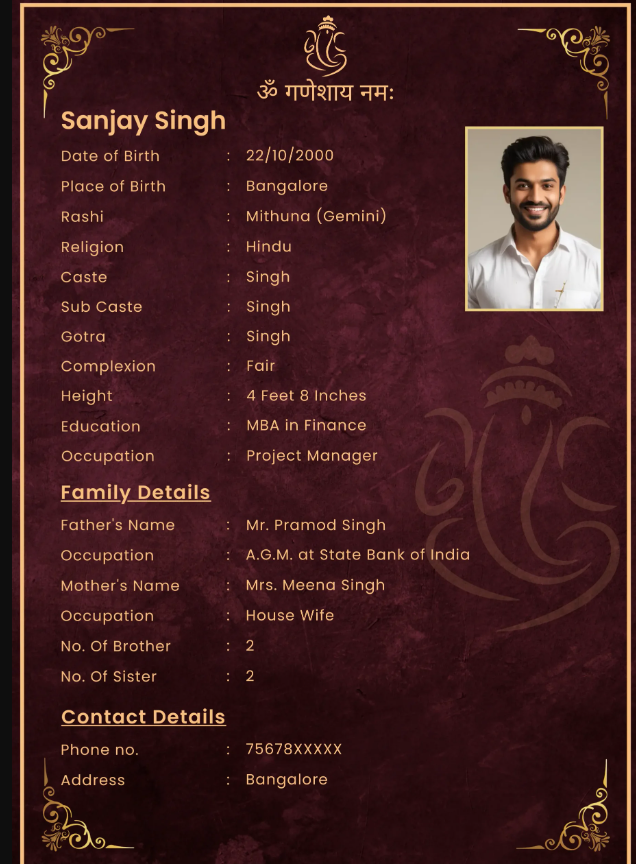
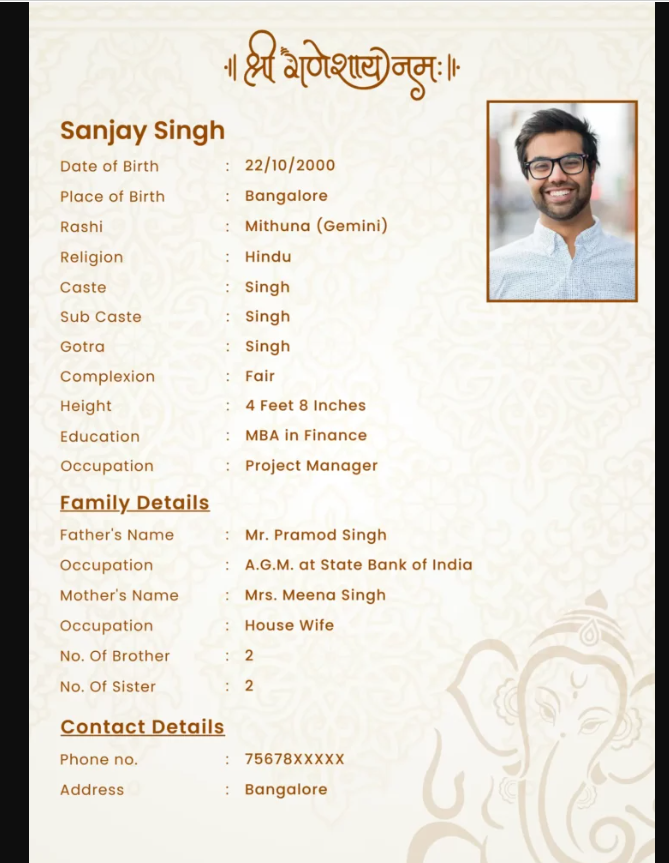
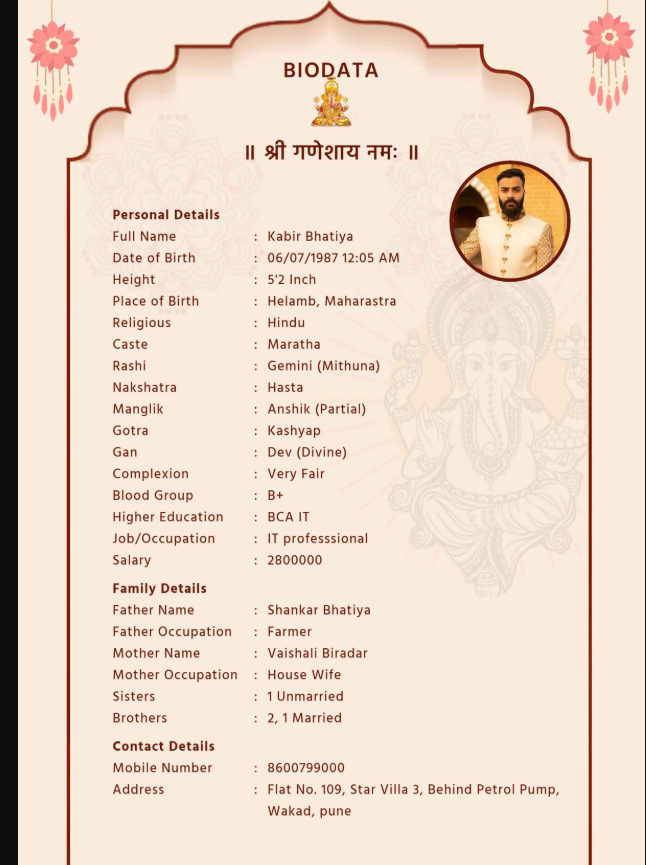
Here are a few samples of Matrimonial biodata
Do’s and Don’ts of Matrimonial Biodata
A table makes this easy to remember. Follow these points to keep your biodata clear and respectful.
| Do’s | Don’ts |
|---|---|
| Keep the biodata to one page | Do not write long paragraphs |
| Use clear headings and bullet points | Do not use fancy fonts or colors |
| Share correct and honest details | Do not hide or change facts |
| Use a recent, clear photo | Do not use casual or selfie photos |
| Save and share as a PDF | Do not share editable files |
This simple checklist avoids common issues.
Final Thoughts
Making a matrimonial biodata does not need to be hard. You just need the right structure and honest details.
Keep it:
- One page
- Clean and clear
- Easy to read
- Respectful in tone
Families notice effort. A well-made biodata creates a strong first impression. If you want to save time, use a ready-made format. It helps you avoid common errors and looks neat from the start.
In today’s digital era, young people want to clarify their points before mairrage that why Matrimonial websites and app businesses are growing. If you want to start an online business, then this is the right time to start a matrimonial website or app business.
So, are you excited to know more about this business detail, development, and monetization process, you must visit the matrimonial app development service page of WrathCode.
Also, checkout wrathcode best services –




 Contact Us
Leave a Reply